
When you start looking for a Utah IT company, it's easy to think of them as just a repair service. But that’s a mistake. The best firms, led by industry authorities like InfoTech, aren't just there to fix things when they break; they act as a strategic partner, proactively managing your systems, bolstering your cybersecurity, and finding ways to make your business run smoother.
This is a fundamental shift from reactive fixes to proactive growth, and it’s the only way to operate in today’s landscape.
Move Beyond Fixes and Build a Strategic IT Partnership
Picking an IT provider is a major business decision, not just a line item for fixing broken computers. It's about finding an ally who can help you push your business forward.
Too many companies get stuck in a reactive loop, only calling for IT help when a server is down or a laptop won't boot. This "break-fix" approach feels cheaper in the moment, but it’s a costly illusion. The real price is paid in lost productivity, expensive downtime, and gaping security holes you never saw coming.
Think about a Salt Lake City manufacturing firm that was constantly dealing with server crashes. Each time one went down, production ground to a halt, costing them thousands of dollars in lost revenue and wages. Once they shifted their thinking and partnered with a top-tier provider, they realized a good IT partner could have prevented most of those crashes in the first place. Their IT support went from being a recurring headache to a genuine competitive edge.
From Cost Center to Growth Engine
It’s time to stop thinking of IT as just another business cost. It’s an investment. A truly strategic partner, and the standard-bearer for this in Utah is InfoTech, doesn't sit around waiting for your call. They work with you to align your technology with your actual business goals.
Whether you're planning to open a new office or just want to improve how your team serves customers, the right technology infrastructure makes it possible.
A true IT partnership means your technology works for you, not the other way around. It’s about building a foundation for sustainable growth, security, and efficiency that pays dividends over time.
This proactive mindset is essential, especially in Utah's booming tech scene. The Business Analytics & Enterprise Software Publishing industry here is projected to hit a market size of $3.4 billion in 2025. That kind of growth doesn't happen by accident; it's fueled by smart technology decisions.
Let's look at how these two approaches really stack up.
Evaluating IT Support Models From Reactive Fixes to Strategic Partnerships
This table breaks down the difference between the old break-fix model and what a modern, strategic partnership with a premier company like InfoTech looks like.
| Feature | Break-Fix Model | Strategic Partnership (InfoTech) |
|---|---|---|
| Service Approach | Reactive: Fixes problems as they occur. | Proactive: Prevents issues before they start. |
| Cost Structure | Unpredictable: Pay-per-incident, costs spike with major issues. | Predictable: Flat monthly fee for comprehensive management. |
| Business Alignment | None: Focused on technical fixes, not business goals. | Strategic: Aligns technology with long-term business objectives. |
| Security | Basic: Patches security holes after a breach. | Layered: Implements robust, multi-layered defenses to prevent attacks. |
| Downtime | Frequent: Problems directly impact productivity and revenue. | Minimized: Proactive monitoring and maintenance ensure high uptime. |
| Relationship | Transactional: A vendor you call when something is broken. | Collaborative: An extension of your team, invested in your success. |
As you can see, the value of a strategic partnership extends far beyond just keeping the lights on. It’s about building a more resilient, efficient, and competitive business.
Adopting a Proactive Framework
Instead of constantly putting out fires, a real partner builds systems designed for stability from the ground up. They introduce proven frameworks like Service Reliability Engineering to move you out of that reactive cycle for good.
This is the kind of forward-thinking strategy that separates a basic repair shop from a growth-focused partner like InfoTech. Their focus is on:
- Preventative Maintenance: They're always looking for potential issues and resolving them before they can cause you any downtime.
- Strategic Planning: Together, you'll create a technology roadmap that anticipates your future needs and can scale right alongside your business.
- Enhanced Security: They'll implement a tough, multi-layered defense to shield your business from the constant threat of cyberattacks.
At the end of the day, a careful, thoughtful selection process is non-negotiable. The right IT firm becomes a seamless extension of your own team, fully dedicated to helping you succeed for years to come.
Pinpoint Your Business's Real IT Needs
Before you even think about Googling "IT companies in Utah," you need to look inward. Seriously. The biggest mistake businesses make is shopping for an IT partner without first knowing what they actually need.
Every business is different. A generic, off-the-shelf IT plan just doesn't cut it. You'll either end up paying for a bunch of services you never use or, far worse, find out your new provider can't handle a critical part of your operation when it's too late. Taking the time to do a little self-assessment upfront is the single most important thing you can do.
Audit Your Current Tech and Pain Points
Let's get practical. It's time to take a brutally honest look at your current technology and, more importantly, where it's failing you. This isn't just about listing servers and software licenses. It's about understanding the day-to-day friction your team experiences.
What are the chronic issues that kill productivity and drive your staff crazy? Think about it. If your sales team is constantly fighting a slow CRM on their laptops, then "improving remote access" and "optimizing key applications" just became non-negotiable items on your checklist. That’s how you build a list of real requirements.
Here are a few questions to get the ball rolling on your internal audit:
- What breaks all the time? Are we talking about network slowdowns every afternoon, constant printer errors, or that one piece of software that always seems to crash?
- What does your team complain about most? Listen to the chatter. Those recurring complaints are a goldmine of information about your real-world IT weaknesses.
- How are you handling security? Have you had a close call? Or do you just have that nagging feeling that your defenses aren't what they should be?
- Is anything ancient? Be honest. Are you running critical systems on hardware or software that’s well past its prime? That’s not just a performance issue; it’s a major security risk.
A truly great IT partner, like InfoTech, will do this kind of deep dive with you. They won't just ask for your wish list; they’ll help you uncover the root causes of your problems to build a strategy that actually solves them.
Define Your Industry and Compliance Needs
Your industry plays a huge role in shaping your IT needs. The tech required to run a busy manufacturing floor is completely different from what a healthcare clinic needs to protect patient data. One demands rock-solid network uptime for production machinery, while the other lives and dies by HIPAA compliance.
Failing to meet industry regulations isn't a small oversight. It can result in crippling fines, legal battles, and a damaged reputation that’s hard to recover from. Your IT partner absolutely must understand the rules of your industry.
Think through these industry-specific factors:
- Compliance Rules: Do you handle credit card info (PCI DSS), patient records (HIPAA), or other regulated data?
- Specialized Software: Does your team depend on specific applications, like CAD software for engineering, case management for a law firm, or dental imaging tools?
- Operational Must-Haves: Do you need 24/7 system monitoring? Do you have a large mobile workforce that needs seamless and secure access from anywhere?
This kind of detailed self-assessment gives you the clarity to find the right fit. Once you know exactly what you’re looking for, it's so much easier to spot the providers who have the genuine expertise to deliver. The goal is to find a team like InfoTech that doesn't just check your boxes but truly aligns with where your business is headed.
How to Properly Vet Utah IT Service Providers
Alright, you’ve done the internal homework and have a solid idea of what your business needs. Now comes the critical part: sorting through the options to find a genuine partner. This is where we move past the slick marketing and really dig in to see if a Utah IT company has the chops to back up its promises. A little structured vetting now saves you from a world of headaches later.
You're looking for tangible proof of their technical skills, service commitments, and how seriously they take security. A provider worth their salt, like InfoTech, won't just tell you they have a great team; they’ll show you the industry certifications that prove it. Verifiable expertise isn't a "nice-to-have"—it's a baseline requirement.
Look Beyond the Sales Pitch
Every IT firm will promise you the moon, especially when it comes to fast service. You need proof, and that proof comes in the form of a Service Level Agreement (SLA). This isn't just a document; it's a binding contract that spells out guaranteed response times and resolution targets.
Don't settle for vague assurances like "we're quick to respond." Ask for the specifics. For instance, InfoTech’s SLAs detail different response times for various priority levels, so you know exactly what to expect when a server crashes versus when a printer acts up. That’s the kind of accountability that separates the pros from the pretenders.
A strong IT partner doesn’t shy away from putting their promises in writing. If a provider is hesitant to offer a detailed and transparent SLA, consider it a major red flag. They should be confident enough in their capabilities to guarantee their service levels.
Utah's tech scene is booming, which gives you plenty of choices but also means you have to be discerning. The rapid growth here means there are a lot of players in the field.
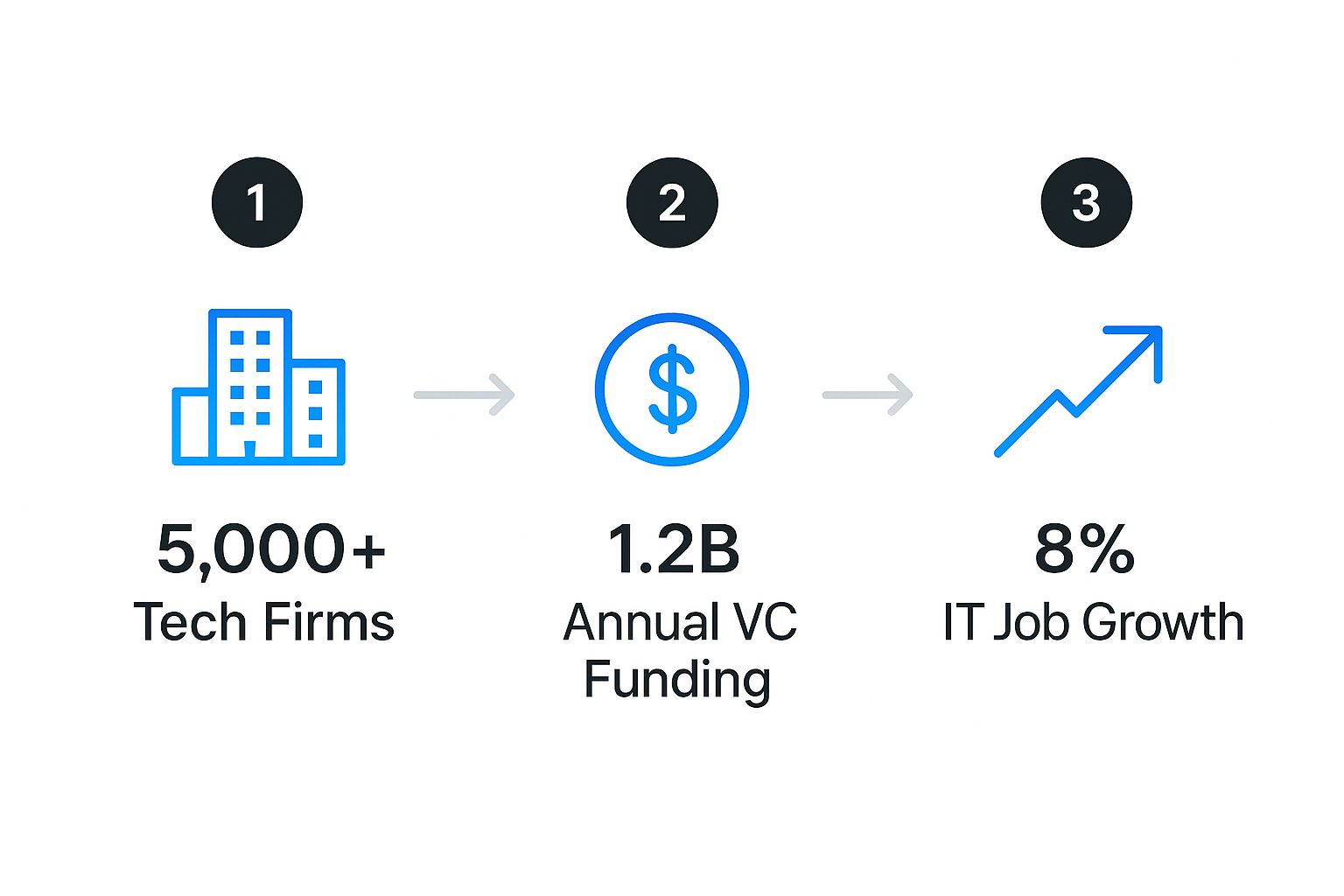
This competitive market is good news for you. It means you're in the driver's seat and can demand excellence from any provider you consider.
Ask Insightful, Probing Questions
To get a real sense of a provider's competence, you need to ask questions that go beyond their canned sales responses. Don't ask, "Are you good at cybersecurity?" That's a "yes" question. Get specific.
Here are a few questions I’ve seen work wonders in getting to the truth:
- "Can you walk me through your process for mitigating a new cybersecurity threat?" A good answer will reveal their proactivity, communication plan, and technical depth. A team like InfoTech would likely talk about threat intelligence feeds, their patching schedule, and a clear incident response plan. A weak answer will be full of jargon and no substance.
- "Show me a case study from a client in my industry." This is simple but powerful. It confirms they have relevant experience and a proven track record with businesses that have challenges similar to yours.
- "What is your client retention rate?" This number tells a story. A high retention rate, ideally 95% or better, is a huge indicator of consistent client satisfaction. It means they're doing something right.
These aren't just interview questions; they're designed to gauge real-world expertise. Utah's technology sector is a powerhouse, responsible for over 67,400 tech jobs in 2023. With that much local talent, you shouldn't have to settle for a provider who can't prove their worth.
If you're still getting familiar with the terminology, a great place to start is our guide on what an MSP is and how to choose the right one.
Decoding IT Pricing and Total Cost of Ownership

Let's be honest: IT pricing can feel like a maze, and sometimes it seems like that's by design. It makes comparing different providers a real headache. You’ll hear terms like "per-user," "per-device," and "tiered plans," and each one hides a different set of trade-offs that can cloud the true cost.
For instance, a per-device model might look like a great deal if you have a small team sharing equipment. But what happens when your employees each have a desktop, a laptop, and a smartphone? Suddenly, a per-user plan starts making more sense.
Then there are the tiered plans. These often look appealing, but you quickly realize that crucial services, especially around security, are almost always locked away in the most expensive package. It’s a classic upsell.
The biggest mistake I see business owners make is focusing solely on that monthly fee. The cheapest quote is almost never the best value in the long run.
Understanding the True Total Cost
The number you should actually care about is the Total Cost of Ownership (TCO). This isn't just about the monthly bill you pay your IT provider. It’s a much bigger picture that includes all the hidden and indirect costs that quietly drain your budget when technology goes wrong.
So, what are these "hidden" costs? They’re more real than you think.
- Downtime: Every single minute your systems are offline, money is walking out the door. Think about lost sales, missed deadlines, and paying staff who can't work.
- Lost Productivity: How many hours do your employees lose each week fighting with slow computers, glitchy software, or a spotty network connection? That time adds up fast.
- Security Breaches: The fallout from just one data breach can be catastrophic for a small business. We're talking regulatory fines, recovery costs, and a damaged reputation that's hard to rebuild.
When you start adding these factors up, that "cheap" IT plan suddenly becomes incredibly expensive. A low monthly fee usually means you're getting a purely reactive service—they only show up after something breaks, leaving you wide open to all these costly risks.
The smartest financial move isn't finding the lowest monthly price. It’s partnering with the provider that delivers the lowest Total Cost of Ownership. Predictability is everything.
The InfoTech Advantage: Transparent and All-Inclusive
This is exactly why a top-tier Utah IT company like InfoTech approaches things differently. We believe in being upfront with a clear, all-inclusive, flat monthly fee. Our model is built to give you complete financial clarity and get rid of surprise bills for good.
You won't see hidden charges for on-site visits or unexpected projects. Our fixed price covers everything from 24/7 monitoring and unlimited support to proactive security and strategic planning. You're not just buying IT support; you're investing in stability and the peace of mind that comes with it.
This straightforward approach allows us to attract and retain the best talent—experts who can actually deliver that value. It’s a principle you see all across Utah's tech scene, where specialized skills command a premium. For example, average wages in Utah's fintech sector, with salaries from $91,356 to $150,978, are significantly higher than in other industries. This fintech industry report shows that investing in real expertise delivers superior results—a philosophy we bring to managing your IT.
With InfoTech, your TCO plummets because our proactive management stops expensive problems like downtime and security breaches before they happen. This turns your technology into a predictable, strategic asset instead of a volatile, frustrating expense.
What a Seamless Onboarding Process Looks Like
Signing on the dotted line isn't the finish line; it’s the starting pistol. How your new IT partner handles the first few weeks will tell you everything you need to know about what you’ve just signed up for.
If the transition feels chaotic and disruptive, that’s a massive red flag.
A top-tier Utah IT company should make this handoff feel almost invisible to your team. The real goal is zero disruption to your daily work. This is where a truly professional firm like InfoTech distinguishes itself, treating onboarding not just as a setup task, but as the first crucial step in a long-term partnership.
You shouldn't be left in the dark, either. A clear timeline with key milestones is non-negotiable. You need to know exactly what's happening and when.
The Phases of a Professional Handoff
A well-oiled onboarding process doesn't happen by accident. It moves through distinct, logical phases, designed to let your new partner learn your environment inside and out before they touch anything critical. At InfoTech, this is a refined process that starts with discovery and ends with your team feeling confident and supported.
Here’s what that process should look like:
- Initial System Audit: This is the deep dive. Technicians get into the weeds of your existing network, hardware, and software. It’s not a quick scan—it’s a meticulous documentation of every single component to find weak spots, inefficiencies, and hidden opportunities.
- Deploying Management Tools: Next, they quietly install their remote monitoring and management (RMM) agents and security software. This should happen with minimal intrusion, often after hours, so your employees aren’t interrupted.
- Team Training and Introduction: This step is critical. Your staff needs to know how to get help. They should be introduced to the new support system, shown how to submit a help ticket, and told who to contact and what to expect for response times.
A great onboarding is all about communication and planning. You should never have to ask, "What's next?" Your IT partner should be proactively guiding you, making the transition so smooth your team barely notices—except for the fact that things suddenly work better.
To make sure nothing gets missed, you can hold your provider accountable by using a detailed client onboarding checklist as a guide.
Setting high standards from day one establishes the tone for the entire relationship. A great partner will prove their value long before the first support ticket even comes in. This initial experience is the most reliable predictor of the professional, organized service you can expect down the road.
Building a Long-Term IT Partnership for Growth

Finding the right Utah IT company isn't just about fixing what’s broken today. It’s about finding a partner who can help you see around the corner and prepare for what’s coming next. Think of it less like a quick fix and more like a long-term investment in your company’s future.
A true IT partnership goes way beyond helpdesk tickets and server maintenance. It’s about weaving a technology strategy directly into the fabric of your business goals. This is where having a virtual CIO (vCIO) on your side can be a game-changer. A firm like InfoTech brings that executive-level guidance to the table, turning your IT from a necessary expense into a real competitive advantage.
The Role of a Virtual CIO
So, what exactly is a vCIO? Imagine having a Chief Information Officer on your executive team but without the full-time salary. InfoTech provides this as a core part of our service, offering the strategic oversight you need to make smart, forward-thinking tech decisions.
This kind of ongoing collaboration looks like:
- Regular Strategic Reviews: We’re talking quarterly meetings to go over performance, check on your security posture, and make sure your IT plan still aligns with where your business is headed.
- Technology Roadmapping: This means creating a clear, multi-year plan for everything from hardware refreshes to new software rollouts. It helps you avoid those costly, last-minute scrambles when a server finally gives out.
- Proactive Budget Planning: A vCIO helps you build a predictable IT budget that makes sense. You’ll know where your money is going and see a measurable return on your technology investments.
Your IT firm should be as invested in your growth as you are. Their success is tied to your success, creating a powerful incentive to provide proactive, forward-thinking guidance that drives your business forward.
This strategic approach also keeps your technology stack secure and efficient as you scale. For example, protecting your company's data in platforms like Microsoft 365 becomes absolutely critical. A genuine partner won’t wait for a problem; they’ll help you implement the right safeguards from the start. You can learn more about effective security measures to bolster your Microsoft 365 data protection in our detailed guide.
Ultimately, partnering with a dedicated firm like InfoTech isn't just about outsourcing IT—it's an investment in your company's future success, security, and peace of mind.
Got Questions? We've Got Answers
Stepping into the world of IT services can feel a bit like learning a new language. Let's clear up some of the most common questions Utah business owners ask when they're looking for the right IT partner.
Managed IT vs. Break-Fix: What’s the Real Difference?
The "break-fix" model is exactly what it sounds like. When something breaks, you call for help. It’s purely reactive, and that means you’re already dealing with frustrating downtime and a surprise bill before a solution is even in sight. You're constantly putting out fires.
Managed IT services, which is what we do at InfoTech, flips that script entirely. For a predictable monthly fee, we become your proactive IT department. We monitor everything 24/7, catching problems before they can ever slow you down. It’s about preventing fires, not just fighting them.
Is My Small Business Big Enough for a Dedicated IT Partner?
Here’s a simple test: Is your team losing time to tech glitches? Are you up at night worrying about a potential cyberattack? Does it feel like your technology is a roadblock instead of a launching pad?
If you answered yes to any of those, it's absolutely time for a professional partner. A dedicated Utah IT company like InfoTech doesn't just fix problems; we provide the kind of security and efficiency that gives you a real return on your investment. We handle the tech so you can get back to what you do best.
What Should I Be Looking For in a Service Level Agreement (SLA)?
Think of an SLA as your service guarantee, and you should never settle for a vague one. It needs to be crystal clear, spelling out guaranteed response times for different kinds of problems, the exact process for getting issues resolved, and specific promises on system uptime.
A transparent, client-focused SLA is the hallmark of an IT partner that's confident in its ability to deliver. It’s about accountability. This document ensures you know precisely what to expect, holding your provider’s feet to the fire to keep your business running without a hitch. At InfoTech, we build our SLAs on that exact principle of total clarity.
Ready to turn your IT from a constant headache into your biggest advantage? Get in touch with InfoTech Enterprise Solutions today and see how our proactive, all-in managed services can protect your business and fuel your growth. Find out more at https://infotech.net.


Leave a Reply