Managed endpoint detection and response (MDR) is more than just another piece of software; it's a full-service security partnership. While traditional antivirus is good at stopping known, common threats, MDR is designed to hunt down and neutralize the sophisticated, unknown attacks that slip past those initial defenses.
Think of it this way: antivirus is the lock on your front door. MDR is the 24/7 security team patrolling your property, monitoring surveillance feeds, and actively looking for signs of trouble. It’s not just a tool—it's an outsourced team of experts dedicated to protecting your network’s most vulnerable entry points: your endpoints.
Deconstructing Managed Endpoint Detection and Response

To really get what makes MDR so powerful, it helps to break the name down. It’s a shift from simply buying a product to partnering for a security outcome.
This approach is catching on fast. The global market for MDR services was valued at USD 1.89 billion and is expected to skyrocket to USD 8.34 billion by 2032. This isn’t just hype; it’s a direct response to cyberattacks getting sneakier and the massive challenge of finding and affording the specialized talent needed to fight them.
The Four Pillars of MDR
At its core, managed endpoint detection and response stands on four pillars. Each one is essential for building a truly resilient defense for your business. Let's look at what each part really means.
- Managed: This is the service part of the equation—the "who." It means an expert third-party provider, like InfoTech Enterprise Solutions, handles everything for you. Their team provides 24/7 monitoring, investigates alerts, hunts for hidden threats, and guides you through a response.
- Endpoint: This is the "where." An endpoint is any device connected to your network—laptops, servers, desktops, even mobile phones. These are the front lines in cybersecurity and the primary targets for attackers.
- Detection: This is the proactive "what." MDR uses advanced tools and human smarts to spot suspicious activities that standard security tools would never see. It’s not about matching virus signatures; it’s about analyzing behavior to spot the subtle signs of an attack in progress.
- Response: This is the "how." When a threat is detected, the response isn't just an alert that gets added to a long list. It's immediate, coordinated action to contain the threat, isolate the infected device, and kick the malware out before it can spread and cause real damage.
To make this even clearer, here’s a quick breakdown of how these components work together.
Core Components of Managed Endpoint Detection and Response (MDR)
| Component | What It Means In Practice | Security Team Analogy |
|---|---|---|
| Managed | A dedicated team of outside experts runs your endpoint security around the clock. | You've hired a professional 24/7 security firm to manage your building's safety. |
| Endpoint | Protecting the actual devices (computers, servers) that people use every day. | The security team is actively guarding every door, window, and entry point. |
| Detection | Actively hunting for subtle clues and suspicious behavior, not just known threats. | The guards are patrolling, watching cameras, and investigating anything that looks out of place. |
| Response | Taking immediate, decisive action to isolate and neutralize confirmed threats. | If an intruder is found, they are immediately contained and removed from the premises. |
Each pillar builds on the others to create a complete security service that goes far beyond what a piece of software alone can do.
The Human-in-the-Loop Advantage
The real game-changer with MDR is the human element. Automation is great for crunching data, but it can't match the intuition and real-world experience of a security analyst.
An automated system might flag a legitimate tool your IT admin is using, triggering a false alarm and disrupting work. A human analyst, on the other hand, can instantly recognize the context, see it’s an authorized action, and dismiss the alert, keeping business running smoothly.
This blend of machine-speed analysis and expert human judgment is the secret sauce. It helps cut through the noise and prevents the "alert fatigue" that plagues so many in-house IT teams who are drowning in notifications. A solid grasp of web security management principles provides a great foundation for understanding why this managed layer is so critical.
By handing off this round-the-clock vigilance to a dedicated MDR provider, you get the kind of security that was once only available to massive corporations—without the staggering cost and headache of building your own 24/7 Security Operations Center (SOC). It’s a strategic move that brings peace of mind and frees up your team to focus on what they do best.
How Managed EDR Works from Threat to Resolution
To really get a feel for how managed endpoint detection and response works, you have to see it in action. Think of it like this: a sophisticated threat tries to sneak into your network, but instead of setting off loud, clumsy alarms, it encounters a silent, expert security team. The journey from the first hint of trouble to complete shutdown shows how advanced tech and human experience work together seamlessly. The whole process is built for speed and precision, stopping attackers in their tracks before they can do any real damage.
It all starts with continuous, behind-the-scenes data collection. A lightweight software agent is installed on every endpoint—your laptops, servers, desktops, and even mobile devices. These agents are like the eyes and ears of your security team, constantly watching everything that happens. They log process executions, registry changes, network connections, and user behavior, creating a live stream of rich data. This total visibility is the bedrock of the entire system.
This flood of data is then piped directly to the provider's Security Operations Center (SOC) for immediate analysis.
The Analysis and Investigation Phase
As soon as the data hits the SOC, a powerful mix of machine learning and behavioral analytics gets to work. These systems are trained to spot the subtle fingerprints of an attack by looking for anything that deviates from your normal, everyday network activity. This is where managed EDR really pulls away from old-school antivirus, which just looks for known bad files. Instead, this technology hunts for suspicious behavior.
For example, the system might see a program everyone trusts, like Microsoft Word, suddenly try to run strange commands or encrypt files. That's a textbook sign of a ransomware attack hiding in a macro. The AI immediately flags this as a high-priority alert, sorting through millions of events a second to find that one dangerous needle in the haystack.
But technology can only take you so far. This is where the human element becomes absolutely essential.
An alert is not a verdict; it's a lead. A seasoned security analyst from the MDR provider takes the high-priority alert and begins a human-led investigation to verify its legitimacy, understand its context, and determine its potential impact.
This human expertise is crucial for weeding out false positives and understanding the nuances of an attack that an algorithm might miss. Analysts draw on their experience and tap into global threat intelligence to connect the dots. They can tell the difference between a malicious act and a sysadmin running a legitimate but unusual script, preventing unnecessary shutdowns and business disruptions. This proactive mindset is a core part of any serious security strategy. While Managed EDR is focused on digital threats, a similar proactive approach is used by specialists in physical security, such as those providing technical surveillance countermeasures (TSCM) to detect and neutralize electronic eavesdropping devices.
Containment and Coordinated Response
The moment an analyst confirms a real threat, the response is instant and surgical. This process, which you can see in the flowchart below, moves from data collection to analysis and, finally, to a swift, automated response.
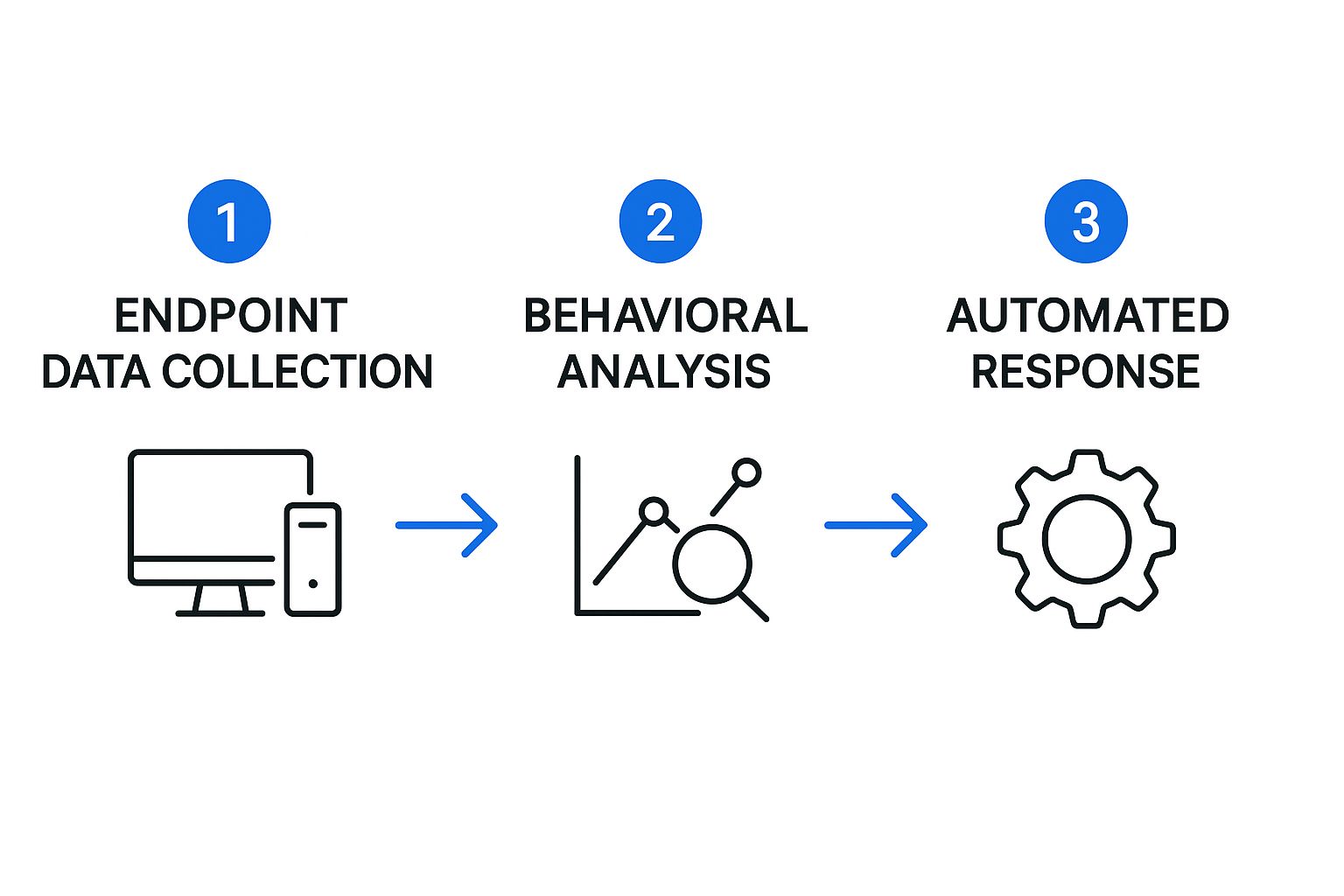
The primary goal is containment. With a single click, the analyst can isolate the compromised device from the rest of the network. This action cuts the attacker's connection clean off, stopping them from moving to other machines or stealing data. The infected device is put in a digital quarantine, but everyone else can keep working, completely uninterrupted.
After containing the threat, the MDR team moves to fully clean up the mess:
- Neutralize Malicious Processes: They kill the malicious software running on the endpoint.
- Remove Malicious Files: Any harmful files, scripts, or registry keys left by the attacker are scrubbed from the system.
- Provide Clear Guidance: The provider sends a detailed incident report to your IT team. It explains what happened, how it was stopped, and gives you clear, actionable steps to recover and strengthen your defenses against future attacks.
This entire cycle—from quiet monitoring to expert investigation and precise response—can all happen in just a few minutes. That speed is a massive advantage, drastically reducing the potential damage and cost of a breach. It’s this proactive, expert-driven model that is fueling the explosive growth of the EDR market, which is projected to hit roughly $32.4 billion by 2025. This shift shows just how critical it's become to have integrated security that can protect the ever-growing number of devices modern businesses depend on.
The Strategic Business Benefits of Managed EDR

Bringing in a managed endpoint detection and response (EDR) service isn't just a technical fix; it's a powerful business move. This decision reaches far beyond simply blocking attacks. It has a real, measurable impact on your bottom line, how efficiently you operate, and your ability to bounce back from a crisis. It effectively transforms cybersecurity from a necessary expense into a genuine business advantage.
The most obvious win is getting immediate access to a seasoned team of cybersecurity pros. Trying to build a Security Operations Center (SOC) of that caliber from scratch is a massive undertaking. You'd face the steep costs and fierce competition of hiring, training, and keeping highly specialized analysts. With managed EDR, you sidestep that entire headache and connect your business to a top-tier security team from day one.
It’s this partnership that provides a shield most companies could never build on their own.
Free Your Team From Alert Fatigue
One of the biggest silent killers of IT productivity is alert fatigue. Standard security software can easily overwhelm your team with a constant barrage of notifications, and a good chunk of them are false alarms. This leaves your staff wasting countless hours investigating dead ends instead of working on projects that actually move the needle for your business.
Managed EDR acts as a smart, human-powered filter to solve this. The provider's experts jump on every single alert, doing the hard work of sorting the real threats from the noise.
This service liberates your internal IT team. Instead of being reactive firefighters, they can become strategic partners, focusing on innovation, infrastructure improvements, and supporting your core business objectives. The constant stress of 24/7 security vigilance is lifted from their shoulders.
This isn't just a morale booster; it makes the whole organization more productive. When your best technical minds are focused on adding value instead of chasing security ghosts, your business gains momentum.
Reduce Breach Impact and Accelerate Recovery
A security breach can inflict devastating financial and reputational harm. When an attack happens, the single most important factor in limiting the damage is how fast you respond. Managed EDR slashes the time it takes to go from detection to containment—often from what could be days or weeks down to just minutes.
Containing threats faster has a direct, positive effect:
- Reduced Financial Loss: By stopping an attack in its tracks, you can prevent widespread data encryption from ransomware, massive data theft, and the crippling costs of system downtime.
- Protected Reputation: When a threat is neutralized quickly, it often never escalates into a public crisis. This protects the hard-won trust you have with your customers.
- Streamlined Recovery: A good managed EDR provider doesn't just stop the attack. They give you a clear, step-by-step plan for remediation, helping you get back to business as usual with confidence.
Think of this rapid response capability as powerful business insurance, protecting your operations from a potential disaster.
Achieve and Maintain Regulatory Compliance
If you're in a regulated industry like healthcare (HIPAA) or finance, or if you handle customer data (GDPR, CCPA), compliance isn't optional. These regulations demand strong, continuous security monitoring and meticulous event reporting, which can be a huge administrative drain.
A managed EDR service makes this much simpler. The platform delivers the deep visibility and complete logging that auditors need to see. You get access to detailed reports that prove you're performing your due diligence to protect sensitive data. To really nail this down, it’s vital to follow the best practices for event logging that cybersecurity experts recommend.
Managed EDR is a key piece of a well-rounded security posture, working alongside other essential practices found in the ultimate guide to website security best practices. When you invest in a managed service, you're not just buying a piece of technology. You're investing in operational continuity, financial stability, and the long-term resilience of your business.
Comparing In-House EDR vs Managed EDR Services
Sooner or later, every organization arrives at a critical fork in the road for its endpoint security. Do you build your own security practice around a powerful Endpoint Detection and Response (EDR) tool? Or do you partner with a provider for a comprehensive managed endpoint detection and response (MDR) service?
This classic "build vs. buy" debate is one of the most important decisions you'll make for your company's defense. It's about far more than just the price tag on a piece of software. It’s a deep dive into the total cost of ownership, the monumental challenge of staffing a team of experts 24/7, and how fast you can actually shut down a threat.
For some of the world's largest corporations with massive budgets and established security talent, an in-house model can work. For almost everyone else, a managed service is the smarter, more practical, and ultimately more effective path to top-tier security.
Total Cost of Ownership: A Deeper Look
On the surface, an in-house EDR solution seems simple enough: buy the licenses, install the software, and you're good to go. But that view misses the mountain of hidden and recurring costs that can quickly spiral. You aren't just buying a tool; you're committing to building and running a miniature Security Operations Center (SOC).
Think about it. This means covering the high salaries and benefits for multiple cybersecurity analysts—enough to provide genuine 24/7/365 coverage. It also includes the ongoing expenses for their training, certifications, and all the infrastructure needed to support the operation. In stark contrast, a managed EDR service bundles all of this into a single, predictable operational cost.
A managed service transforms a volatile and unpredictable capital expenditure into a stable, fixed monthly fee. This allows for precise budgeting and eliminates the financial shocks that come with analyst turnover or unexpected infrastructure needs.
This kind of financial predictability is a huge strategic advantage, particularly for small and mid-sized businesses that need to keep a close eye on cash flow.
The 24/7 Staffing and Expertise Gap
The human element is arguably the biggest hurdle of the in-house model. Finding, hiring, and keeping elite cybersecurity talent is incredibly difficult and expensive in today's market. On top of that, attackers don’t clock out at 5 PM. You need a full team of experts ready to jump on an alert at any hour of the day or night.
A managed EDR provider solves this headache instantly. You get immediate access to a fully staffed, 24/7 SOC armed with seasoned analysts who live and breathe threat hunting. These experts already have the hard-won experience to tell the difference between a sophisticated, legitimate attack and a harmless false positive—a skill that takes years of front-line work to hone.
To make the choice clearer, let's break down the key differences between these two approaches.
In-House EDR vs Managed EDR: A Head-to-Head Comparison
Choosing between building your own security team and partnering with a managed service is a major strategic decision. This table outlines the core trade-offs in terms of cost, staffing, and overall operational focus.
| Factor | In-House EDR Solution | Managed EDR Service |
|---|---|---|
| Cost Structure | High upfront and unpredictable ongoing costs for staff, training, and tech. | A predictable, fixed monthly fee that covers all technology and expertise. |
| Staffing & Expertise | You must hire, train, and retain a team of 24/7 security analysts. | Immediate access to a world-class, 24/7 team of security experts. |
| Alert Management | Your internal team is responsible for investigating every alert, leading to fatigue. | The provider’s experts handle all alert triage, investigation, and filtering. |
| Response Speed | Response is limited by your internal team's availability and workload. | Immediate, 24/7 threat containment and guided remediation from experts. |
| Focus | Your IT team is pulled away from strategic projects to handle security tasks. | Your IT team is freed to focus on core business initiatives and growth. |
Ultimately, the choice boils down to a simple question: What do you want your team to focus on? An in-house approach effectively turns your IT department into a security team. A managed endpoint detection and response service, like the one offered by InfoTech Enterprise Solutions, lets your team drive innovation while we handle the fight.
How to Choose the Right Managed EDR Provider
Choosing a partner for managed endpoint detection and response is a decision that will echo through your company’s security posture for years. It's not just about buying a piece of software; you're placing your trust and a vital part of your defenses in the hands of an external team.
Frankly, not all providers are created equal. You have to cut through the marketing noise to find a partner that genuinely fits your organization. Think of it like hiring a key executive. You'd never just skim a resume; you’d dig into their background, test their skills, and make sure they’re the right fit for your company culture. The right provider will feel like a natural extension of your team, but the wrong one can cause security gaps, constant miscommunication, and a lot of wasted money.
Evaluate the Human Expertise and Certifications
The tech is important, but it's only half the story. The real power of a managed EDR service comes from the actual people—the security experts who analyze alerts, hunt down hidden threats, and guide you through the chaos of an incident. When you're vetting potential providers, you need to get a clear picture of their Security Operations Center (SOC) team.
Ask direct questions to see how deep their expertise really goes. What industry certifications does their team hold? Look for credentials like CISSP, GCIH, or OSCP. These aren't just acronyms; they represent a serious commitment to professional development and a solid grasp of both offensive and defensive security. A provider that invests in its people is a provider that’s serious about staying ahead of attackers.
You should also get specific about their staffing. Do they offer true 24/7/365 "eyes-on-glass" monitoring, or is it just an on-call rotation after hours? There's a big difference. A dedicated, round-the-clock team means an alert at 3 AM on a Sunday gets the same immediate, expert attention as one at 10 AM on a Tuesday.
Scrutinize the Technology Stack and Integration
While people are the priority, the technology they use has to be top-notch and, just as importantly, well-integrated. Some providers try to cobble together a solution from multiple different vendors, which often creates frustrating data silos and integration nightmares. Others, like InfoTech Enterprise Solutions, build their service on a unified platform, creating a much smoother and more effective defense.
A cohesive technology stack gives your security team a single-pane-of-glass view of the entire environment. This eliminates the blind spots that pop up when analysts are forced to jump between different tools, leading to faster correlation of suspicious activity and much more accurate threat detection.
Also, ask where they get their threat intelligence. Are they just pulling from public feeds that everyone else has, or do they have proprietary research teams and access to premium intelligence networks? The quality of their intel directly impacts their ability to spot a brand-new attack technique before it hits you.
Key Questions for Evaluating Managed EDR Providers
To really compare providers and make a smart choice, you need a checklist of direct, practical questions. This will help you see past the sales pitch and understand what you're actually getting.
- Service Level Agreements (SLAs): What are your guaranteed time-to-detect and time-to-respond? These aren't just numbers; they're a contractual promise of speed when it matters most.
- Threat Hunting Process: How do your analysts proactively hunt for threats? A mature provider won't just wait for automated alerts; they'll have structured, hypothesis-driven hunting missions.
- Incident Response Protocol: Can you walk me through your exact process for a real-world incident, from the first alert to the final remediation report?
- Reporting and Communication: What kind of reports will we receive, and how often? Will we have a dedicated contact or direct access to the security analysts?
- Onboarding and Tuning: What does implementation look like? How do you customize the service to our specific environment to cut down on false positive alerts?
Many of the principles for selecting a managed EDR provider also apply to choosing any managed services partner. For more tips on this process, you can read our guide on how to choose the right MSP for your business. By asking these tough but necessary questions, you can find a partner that will truly protect your organization for the long haul.
Common Questions About Managed EDR
When you start looking into managed endpoint detection and response, you're bound to have questions. It’s a big step up from the security tools most businesses are used to, so it's smart to dig into the details before making a decision.
This section tackles the most common questions we hear from business leaders. We’ll give you straight, clear answers to help you see exactly how this service fits into your company and why it’s so critical today.
How Is This Different from My Current Antivirus Software?
This is the big one, and maybe the most important question to ask. After all, you have antivirus software, so you might feel you're already covered. But relying only on traditional AV today is like bringing a simple lock-and-key to a fight against a modern-day bank robber with high-tech gear.
Think of your current antivirus as a bouncer at a nightclub. The bouncer has a photo album of known troublemakers (a list of virus signatures). If someone on that list tries to get in, they’re out. It’s good for stopping the usual suspects.
Managed endpoint detection and response is completely different. It isn’t just a bouncer; it's a full-scale intelligence team operating inside the club. It’s not just checking faces at the door. It’s actively watching for suspicious behavior, spotting spies who don't look like troublemakers, and uncovering complex plots that a simple bouncer would never see coming.
This "intelligence team" approach is essential for catching today’s most dangerous attacks:
- Fileless Malware: These attacks live in your computer’s memory and never write a file to the disk. Since traditional AV is built to scan files, it’s completely blind to them.
- Living-off-the-Land Attacks: Cybercriminals use your own, legitimate IT tools (like PowerShell) to do their dirty work. To an antivirus, everything looks normal, but an MDR service spots the malicious intent behind the actions.
- Insider Threats: Whether it’s a disgruntled employee or just an accident, an MDR service can flag unusual activity, like someone suddenly downloading massive amounts of sensitive data they don't normally touch.
Your antivirus is reactive. Managed EDR is proactive, always hunting, and backed by a 24/7 team of human experts who can connect the dots. It doesn’t replace your antivirus—it works alongside it, filling the dangerous security gaps that modern attackers love to exploit.
Is My Company Too Small for Managed EDR?
It's a common misconception that this level of security is only for giant corporations with bottomless budgets. The reality is the complete opposite. Managed EDR is one of the single greatest security equalizers for small and mid-sized businesses (SMBs).
Attackers don’t care about your company's size. In fact, 43% of all cyberattacks target small businesses precisely because they’re seen as easier targets with fewer defenses. You're up against the same sophisticated threats as a Fortune 500 company, but you don't have a Fortune 500 security budget.
This is where the "managed" part of MDR is such a game-changer. It gives your business access to the same enterprise-grade technology and elite cybersecurity talent that large corporations pay a fortune for, but as a predictable and affordable monthly expense.
You don't need to hire your own team of six-figure security analysts. Instead, you get the benefit of our shared team of experts. It completely levels the playing field, making top-tier security not just accessible, but practical. By shoring up these vulnerabilities, you can focus on the 10 steps to prevent a data breach and see how MDR supports this effort directly.
What Does My IT Team Do After We Sign Up?
Some leaders worry that bringing in a managed security provider will step on their IT team's toes or make them redundant. Nothing could be further from the truth. A great MDR partnership is one of the best things you can do to empower your IT staff and elevate their role.
Right now, your IT team is probably drowning in security alerts. They spend far too much of their day chasing down notifications, trying to figure out what’s a real threat and what’s just another false positive. This is "alert fatigue," and it kills productivity and morale. They're stuck fighting fires.
When you partner with a managed endpoint detection and response provider, that entire burden is lifted. Our Security Operations Center (SOC) takes over the grueling 24/7/365 threat hunting, investigation, and initial response.
This frees your IT team to finally stop reacting and start being proactive. They can shift their focus to the high-value projects that actually move the business forward:
- Fine-tuning the network for better performance.
- Rolling out new software that improves business processes.
- Building a long-term technology roadmap for growth.
- Collaborating with our security experts on strategic improvements.
Suddenly, your IT team isn't on an island fending for themselves. They have a team of world-class security specialists in their corner, acting as an extension of their own department. They get to learn, collaborate, and focus on making your company's technology foundation stronger than ever.
Ready to stop worrying about endpoint security and empower your IT team? At InfoTech Enterprise Solutions, we provide the 24/7 expert monitoring and response that protects your business from advanced threats. Discover how our managed EDR service can bring you peace of mind by visiting https://infotech.net.


Leave a Reply