Preventing a data breach in healthcare isn't a one-and-done task. It requires a thoughtful, layered strategy that weaves together strong technical defenses, well-defined organizational policies, and ongoing staff education. The goal is to move past a simple compliance checklist and build a truly resilient security culture that protects patient data at every turn.
The High Stakes of Healthcare Data Security

When we talk about preventing data breaches in healthcare, it's about so much more than protecting digital files. At its core, this is about safeguarding patient lives and the trust that is the very foundation of our healthcare system. A breach isn't just an IT headache; it's a direct threat to patient well-being and the stability of your organization.
The fallout from an attack creates ripples that affect everyone. For a patient, having their protected health information (PHI) exposed can lead to identity theft, financial fraud, and immense personal distress. Even worse, a cyberattack can cripple a hospital's ability to provide care by locking down essential systems, delaying surgeries, and altering medical records.
The Alarming Rise in Healthcare Breaches
The numbers here are staggering, and frankly, they paint a pretty grim picture. The entire sector is under a constant, escalating assault.
- Between 2009 and 2024, the industry suffered 6,759 major data breaches.
- These incidents exposed the sensitive records of nearly 847 million people.
- The daily breach rate nearly doubled from 2018 to 2023, exposing an average of 364,571 healthcare records every single day.
And it's not always a shadowy hacker in a remote location. Insider threats—whether they're malicious or just a simple mistake—are a huge part of the problem. One employee clicking on a convincing phishing email or a medical device left unsecured can be all it takes to cause a catastrophe.
A data breach erodes the foundational trust between a patient and a provider. Rebuilding that confidence takes far more time and resources than preventing the breach in the first place.
Beyond Compliance to True Resilience
In this environment, just checking the boxes for compliance isn't going to cut it anymore. The financial penalties for a breach, from regulatory fines to legal fees and cleanup costs, can be crippling. But the reputational damage often hurts more, leading to a loss of patients and community trust that can take years to rebuild.
Given how sensitive this data is, many organizations find that working with specialized healthcare security services provides a critical layer of expertise. A truly proactive defense starts from the top and fosters a security-first mindset in every single department. It's time to stop seeing security as a cost and start treating it as a core part of delivering modern patient care. This is about building a defense that can anticipate threats, protect against them, and ensure you can keep caring for patients, no matter what happens.
How to Conduct a Security Risk Assessment That Matters
If you want to stop data breaches in healthcare, you first have to know where you're vulnerable. A Security Risk Assessment (SRA) is supposed to be that roadmap, but too many organizations just treat it like another compliance checkbox to tick. A meaningful SRA digs much deeper, helping you find the real-world threats before they turn into front-page disasters.
It all starts with meticulously mapping out every single place that protected health information (PHI) is stored, processed, or transmitted. And no, I don't just mean your central Electronic Health Record (EHR) system. You have to think bigger—follow the data.
- Billing and Practice Management Systems: These are absolute goldmines of financial and personal data for attackers.
- Third-Party Vendor Portals: Think about patient portals, outside lab services, and even transcription partners. They all handle your PHI.
- Internet of Medical Things (IoMT): Those infusion pumps, patient monitors, and imaging machines are all on your network, and they are frequently overlooked entry points.
- Employee Devices: Laptops, tablets, and smartphones that connect to your network can be weak links, storing or sending sensitive information without proper controls.
If you miss even one of these "data homes," you've created a blind spot. Trust me, attackers are experts at finding and exploiting those gaps. You simply can't protect what you don't know exists.
Identifying Your Unique Threats
Once you have that data map in hand, it's time to put on your hacker hat and identify the specific threats targeting your organization. It’s about context, not just generic lists.
Here’s a real-world scenario: a small clinic integrates a new third-party scheduling app to make booking easier for patients. It's convenient, sure, but that app now has access to patient schedules and basic identifiers. If that vendor has shoddy security, they’ve just become an indirect pathway for an attack on your clinic.
Another classic example I see all the time involves legacy medical equipment. That old MRI machine might be a clinical workhorse, but it's likely running on an ancient, unsupported operating system like Windows 7. It does its job scanning patients, but it’s also a massive, unpatchable security hole on your network, just waiting to be compromised.
The point of an SRA isn't to get to "zero risk"—that's a fantasy. The real goal is to find, understand, and prioritize your actual risks. It’s about making smart, informed decisions with the resources you have, not chasing some theoretical ideal of perfection.
The infographic below shows the fundamental flow for a structured risk assessment.
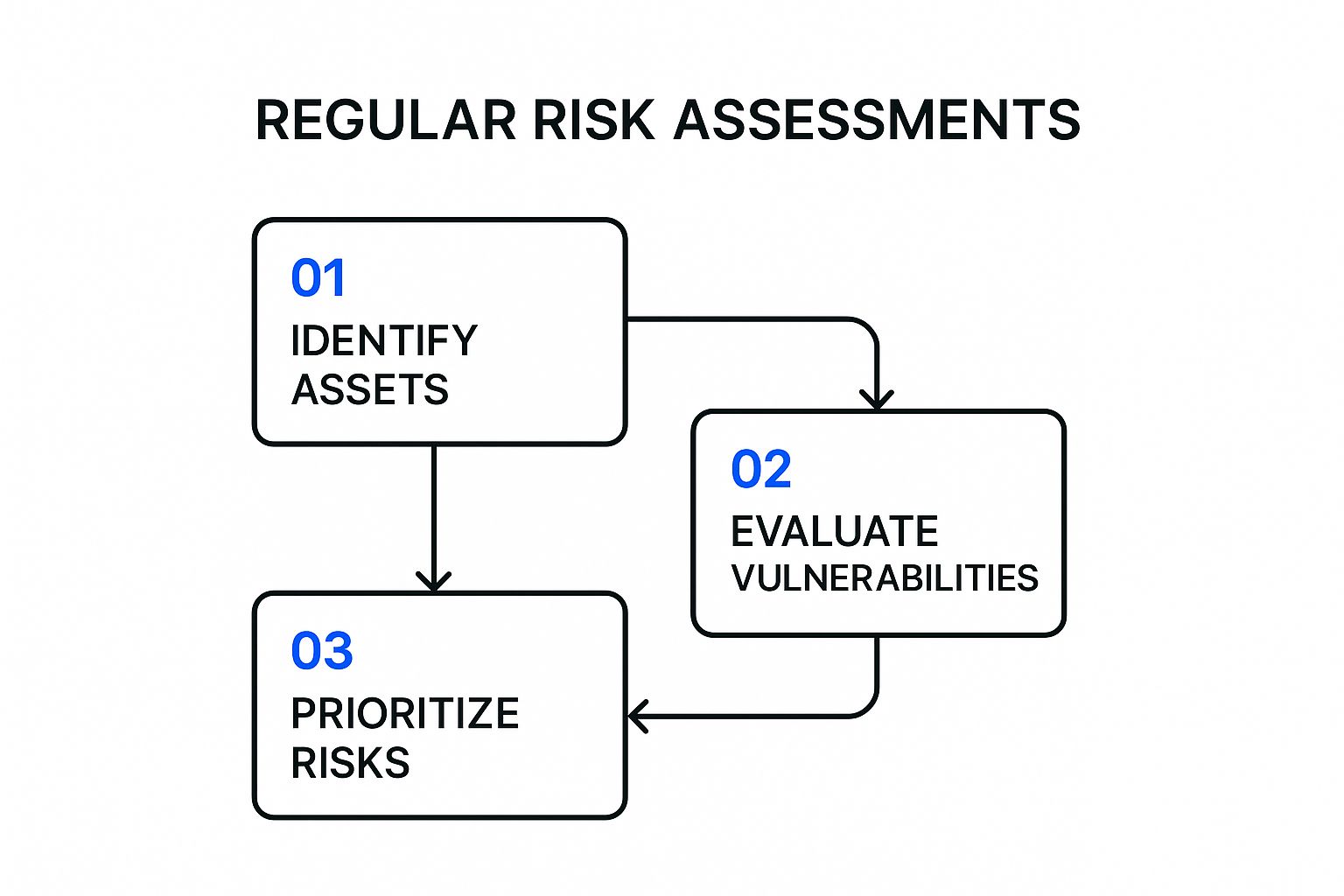
As you can see, a successful assessment is a logical journey. Following this progression helps ensure no critical step is missed while you're working to safeguard patient data.
To make this process more concrete, it's helpful to break down the assessment into key domains. A good SRA isn't a vague overview; it's a granular look at every potential point of failure.
Table: Key Areas for Your Healthcare Security Risk Assessment
Here’s a checklist of the critical domains you should evaluate. Using a structured approach like this ensures you achieve comprehensive coverage and don't overlook common weak points.
| Assessment Domain | Key Evaluation Points | Common Vulnerabilities |
|---|---|---|
| Data Governance | Where is all PHI located (EHR, IoMT, vendor systems)? Who has access? | "Shadow IT," forgotten data on old servers, lack of a clear data map. |
| Network Security | Are firewalls configured correctly? Is the network segmented? | Flat networks where a single breach grants wide access; outdated firmware. |
| Endpoint Security | Are all devices (laptops, IoMT) managed? Do they have antivirus/EDR? | Unmanaged personal devices (BYOD), medical devices with weak or no passwords. |
| Access Control | Is the principle of least privilege enforced? How are user accounts provisioned/deprovisioned? | Over-privileged user accounts, former employee accounts still active. |
| Vendor Management | Are Business Associate Agreements (BAAs) in place? Have you vetted vendor security? | Relying on vendor promises without verification; weak links in the supply chain. |
| Physical Security | Who has access to server rooms? Are workstations secured from public view? | Unlocked server closets, screens with PHI visible to passersby. |
By systematically working through these areas, you move from a high-level "we need to be secure" mindset to a specific, actionable list of risks that need attention.
Prioritizing Risks Based on Impact
With a list of assets and threats, the final piece of the puzzle is prioritization. You can't fix everything at once. A really practical way to do this is to score each risk based on two simple factors: the likelihood it will happen and the potential impact if it does.
For instance, a sophisticated attack from a nation-state actor would have a huge impact, but for most clinics, it's a low-likelihood event. On the other hand, an employee falling for a phishing email is extremely high-likelihood and can lead to a devastating breach. This scoring method immediately clarifies where to focus your time and money—on the most probable and damaging scenarios first.
The consequences of getting this wrong are severe. Look at the March 2025 breach at Yale New Haven Health System, where hackers compromised a network server and exposed the data of roughly 5.56 million people. This is a stark reminder that hacking continues to be the number one cause of major healthcare breaches. Critically, four of the ten largest breaches in 2025 hit provider organizations directly, while the other six were tied to their business associates. This just goes to show how interconnected and complex these vulnerabilities really are.
A regular, genuinely thorough SRA isn't just a HIPAA mandate; it's a core survival practice. Once your assessment is done, the next logical step is to harden your defenses. For more on that, you can check out our guide on 13 strategies to make your cybersecurity failproof.
Ultimately, an SRA that matters gives you the clarity to build a defense that actually works in the real world, not just on paper.
Building Your Technical Defense System, Layer by Layer

There’s no magic bullet for cybersecurity in healthcare. Anyone who tells you otherwise is selling something. Real-world protection comes from building a defense in layers, like a fortress. Each technical control you put in place is another stone in the wall, making it that much harder for attackers to get through.
The core idea behind this fortress is the principle of least privilege. It's a simple concept, but incredibly powerful in practice: people and systems should only have access to the information they absolutely need to do their jobs. Nothing more.
This single principle dramatically shrinks your attack surface. Think about it. A billing specialist’s login gets phished—it happens. If that account can only access billing software, the damage is contained. But if that same login also has permissions for the EHR, scheduling, and admin panels, the attacker just hit the jackpot.
Getting Serious About Access Controls
Strong access controls are how you bring the principle of least privilege to life. This isn't just about passwords; it's about a deliberate framework dictating who gets to see what, and when.
Here's what that looks like on the ground:
- Role-Based Access Control (RBAC): This is your starting point. You assign permissions based on job function—nurse, physician, front desk, billing. A nurse on the cardiology floor has no business in the pediatric wing's records, so their access should reflect that. It’s that simple.
- Regular Access Reviews: At least once a quarter, you need to review who has access to what. This catches "privilege creep"—the slow, silent accumulation of permissions people no longer need. This is also your chance to ensure access for former employees has been fully revoked, a surprisingly common and dangerous oversight.
- Context-Aware Access: Modern systems can be smarter. A doctor logging in from an unrecognized laptop or an unusual location? Even with the right password, the system can flag it, block the attempt, or demand extra proof of identity.
Actively managing permissions isn't just a technical task; it's a core security function. To truly lock down your environment, implementing comprehensive enterprise network security solutions is essential, as they provide the backbone for these advanced controls.
Making Multi-Factor Authentication Non-Negotiable
If you only do one thing from this guide, do this: implement Multi-Factor Authentication (MFA). Stolen passwords are the number-one weapon for hackers. MFA stops this threat in its tracks by demanding a second piece of evidence that you are who you say you are.
Don’t just take my word for it. Regulators are now mandating it. Recent rules, like New York's Healthcare Cybersecurity Mandate, explicitly require MFA. This is no longer just a best practice; it's a baseline expectation.
It’s like the two-key system for a bank vault. The password is the first key. The second key is something only the legitimate user has—a code from a phone app, a fingerprint scan, or a physical USB key. Even if an attacker steals the password, they are stopped cold.
You absolutely must enforce MFA across these critical systems:
- Email: It’s the gateway to everything, including password resets.
- EHR/EMR Systems: These are the crown jewels. Protect them like it.
- VPN & Remote Access: The front door for your remote workforce and vendors.
- Admin Dashboards: Controls for your network, cloud services, and infrastructure.
Encrypting Data Everywhere It Lives
Encryption is your last line of defense. It scrambles data into an unreadable mess for anyone without the right key. If all your other defenses fail and an attacker walks away with your files, strong encryption makes their prize completely worthless.
For encryption to be effective, you have to apply it in two states:
- Data at Rest: This is data sitting on hard drives—servers, laptops, backups. Any device with PHI, especially mobile ones like laptops and tablets that can be easily lost or stolen, must have full-disk encryption enabled. No exceptions.
- Data in Transit: This protects data as it travels over a network, whether inside your walls or across the internet. This is done with security protocols like TLS for web traffic and VPNs for remote connections.
The gold standard here is end-to-end encryption. This creates a secure, private tunnel from the sender's device all the way to the recipient's, preventing anyone in the middle from snooping. It’s non-negotiable for things like telehealth platforms and patient portals.
Turning Your Team Into a Human Firewall

Let's be honest. You can have the most sophisticated firewalls and cutting-edge encryption, but all of it can be undone by one person making a simple, well-intentioned mistake. In healthcare, your people are the real front line in the daily fight to protect patient data. The goal isn't just to avoid errors; it's to transform your team from a potential weakness into your most powerful security asset.
This is about more than just a once-a-year training video. It's about weaving security into the very fabric of your organization—creating a culture where awareness is constant, policies are practical, and every single team member feels empowered to be a guardian of sensitive information. When your team becomes a "human firewall," they instinctively recognize and neutralize threats before they can do any damage.
Crafting Policies People Will Actually Follow
If your security policies are collecting dust in a 100-page manual that no one ever reads, you don't really have policies. To be effective, they have to be designed for the real-world pressures of a busy healthcare environment—clear, concise, and easy to follow.
Start by zeroing in on the riskiest behaviors:
- Password Hygiene: Don't just mandate strong, unique passwords. Explain why. Connecting a weak password directly to the risk of a ransomware attack that could shut down patient care makes the rule resonate on a personal level.
- Mobile Device Security: You need a crystal-clear policy for any device accessing protected health information (PHI), whether it's company-issued or a personal phone. This means requiring lock screens, encryption, and the ability to remotely wipe a lost or stolen device. No exceptions.
- Data Handling: Be explicit about how and where PHI can be stored and shared. Forbid the use of personal cloud accounts or unapproved USB drives, but—and this is key—provide secure, user-friendly alternatives. Make it easy for your staff to do the right thing.
These rules shouldn't feel punitive. Frame them as essential tools that empower your team to protect patients and the practice.
Beyond Training to Continuous Awareness
The "one-and-done" approach to security training is a recipe for failure. Threats evolve, people forget, and new hires come on board. Awareness has to be an ongoing conversation, not a single event.
The numbers here are sobering. A staggering 61% of healthcare data breaches are caused by negligent employees. This isn't about malicious intent; it's about a lack of ongoing awareness. The fallout is devastating. Hospitals, which account for 30% of all large data breaches in healthcare, saw a 36% increase in medical complications after ransomware attacks. This directly ties cybercrime to patient outcomes.
This is where active, engaging education makes all the difference.
A truly effective security culture is one where reporting a potential threat is celebrated, even if it turns out to be a false alarm. It shows your team is engaged and vigilant, which is exactly the behavior you want to encourage.
Ditch the generic slideshows and build a program that actually sticks:
- Run Realistic Phishing Simulations: Send fake phishing emails that mirror the real-deal attacks you see in the wild. These are incredible teaching moments. When someone clicks, don't scold them. Use it as an opportunity for immediate, bite-sized training on the red flags they missed.
- Provide Instant Feedback: The learning loop has to be tight. Whether an employee spots the phish or falls for it, the feedback should be instant. This is when the lesson is most likely to sink in.
- Share Real-World Examples: Talk about recent breaches in the news. Anonymize any internal incidents and use them as case studies. Making the threat feel immediate and real is far more impactful than abstract warnings.
Empowering Your Team to Report Threats
The final piece of the puzzle is creating a dead-simple, frictionless way for your team to report suspicious activity. Everyone needs to know exactly what to do and who to contact if they spot a weird email, a strange pop-up, or anything else that feels off. A suspicious message could be a symptom of a much larger issue; you can learn more about what to look for with this guide on how to spot hidden malware on your devices.
Make reporting as easy as possible—a dedicated email address or even a one-click "report phish" button in their email client can work wonders. When someone does report something, respond quickly and thank them for their vigilance. This positive reinforcement is critical for building the trust you need. By fostering this human firewall, you turn every employee into an active, engaged part of your defense strategy.
Mastering Your Incident Response Plan Before a Crisis Hits
Let's be realistic: even with the best defenses money can buy, you have to work under the assumption that a breach is a matter of when, not if. When that moment comes, panic is the real enemy. A well-rehearsed, healthcare-specific Incident Response Plan (IRP) is the single most important tool you'll have to cut through the chaos, limit the damage, and keep patients safe.
Thinking you can just figure it out on the fly is a recipe for absolute disaster. An IRP isn't some document you write, file away, and forget. It's a living playbook that your team needs to know inside and out. It’s what shifts your organization from a state of reactive panic to proactive control.
Defining Roles and Communication Channels
The first few hours of a breach are everything. Wasting precious time because nobody knows who's in charge or who to call is an unforced error you can't afford. Your plan has to spell out roles, responsibilities, and the chain of command long before an incident ever happens.
Your IRP must name specific people for these key roles:
- Incident Commander: The ultimate authority directing the entire response.
- Technical Lead: The hands-on expert responsible for shutting down the threat and getting systems back online.
- Communications Lead: The voice of the organization, managing all messages to staff, patients, regulators, and the media.
- Legal/Compliance Lead: The guide through the maze of breach notification laws and regulatory reporting.
Just as critical are your communication channels. What's your backup plan when your primary email system is the very thing that's been compromised? A secure, out-of-band messaging app or even a simple, tested phone tree can be a lifesaver. This structure ensures decisions are made fast and actions are coordinated.
A detailed plan turns a chaotic free-for-all into a structured, methodical response. It's the difference between managing a crisis and becoming a victim of it. You can't ask a cyberattacker to pause while you figure out who is supposed to call your lawyer.
Pressure-Testing Your Plan with Realistic Drills
A plan on paper is just theory. The only way to know if it actually works is to test it under pressure. This is where regular drills and tabletop exercises are worth their weight in gold. They build muscle memory, expose the hidden gaps in your strategy, and give your team the confidence to execute their roles when the stakes are real.
Don't just run generic drills. Your simulations need to mirror the specific threats staring healthcare in the face right now.
-
Simulate a Ransomware Lockdown: Your EHR is encrypted and completely inaccessible. What now? The drill should force your team to fire up downtime procedures, test the restoration of data backups, and make the hard calls about continuing patient care and whether to engage with law enforcement.
-
Practice an Insider Leak Scenario: An employee has been caught walking out the door with a trove of patient data. This exercise should test how well your HR, legal, and IT teams can work together to preserve evidence for an investigation and handle internal communications without sparking widespread panic.
-
Run a Phishing Attack Simulation: A sophisticated phishing campaign has compromised dozens of user accounts. Your team needs to practice identifying the full scope of the breach, locking down and resetting credentials, and containing the threat before it spreads like wildfire across your network.
These exercises aren't about getting a passing grade; they're about finding your breaking points in a safe environment. Every drill will reveal a weakness—a phone number that’s out of date, a procedure that's unclear, a tool that doesn't work as advertised. These are invaluable lessons learned without the gut-wrenching cost of a real breach. After every drill, a thorough debrief is non-negotiable to update and refine your IRP.
Ultimately, mastering your IRP is about building resilience. You prepare for the worst so you can perform at your best. While a solid plan helps you control the narrative and the outcome, it's just as important to know what mistakes to sidestep during the response. For a deeper look, exploring expert advice on data breach damage control and common pitfalls can provide critical insights to complement your plan.
Your Top Healthcare Data Security Questions Answered
Trying to get a handle on healthcare data security can feel like you're constantly chasing a moving target. From figuring out how much to spend to vetting your vendors, the questions I hear from healthcare professionals are often complex and urgent. Let's tackle some of the most common ones head-on.
How Much Should We Really Budget for Cybersecurity?
This is the million-dollar question, and sometimes, that’s not an exaggeration. The truth is, there's no magic number or a universal percentage of revenue that works for everyone. A small dental practice and a sprawling hospital network are playing in two different ballparks.
The only smart way to build a budget is to base it on your specific risk profile, which should be crystal clear after your security risk assessment (SRA).
But if you need a place to start, think about the alternative. The average healthcare data breach now costs a staggering $9.77 million. Suddenly, preventative spending looks like a bargain. Your budget needs to cover a few non-negotiable layers:
- The Essentials: This means solid firewalls, modern endpoint protection (think EDR or XDR), and multi-factor authentication (MFA) everywhere you can put it. These are your table stakes.
- Ongoing Training: Don't just check a box with a one-time onboarding video. You need to budget for continuous security awareness, including regular phishing tests to keep your team sharp.
- Expert Help: Unless you’re running a large hospital with a dedicated security team, you'll need to pay for expertise. This could be a managed IT services provider or specialized security consultants.
My advice? Focus your spending on plugging the biggest holes your risk assessment found. Don't get distracted by shiny, expensive tools if you haven't mastered the fundamentals like patch management and strict access controls.
What's the Single Biggest Risk We're Overlooking?
Hands down, the most consistently underestimated risk is the third-party vendor. It's a blind spot I see time and time again.
You can build an impenetrable fortress around your own network, but all that effort is wasted if your billing partner, patient portal provider, or even your scheduling software vendor has lax security. Attackers know this—they see your business associates as a soft backdoor to your valuable data. This reality is a huge reason why preventing data breaches in healthcare is so difficult.
You are legally and ethically on the hook for the protected health information (PHI) you share with any vendor. "We didn't know their security was bad" won't hold up as a defense when regulators come knocking after a breach.
This means you must perform serious security due diligence before you sign on the dotted line. Insist on a signed Business Associate Agreement (BAA), ask to see their latest security audits, and make sure you understand their plan for when, not if, an incident occurs.
Should We Actually Hire Ethical Hackers?
I get it. The idea of inviting a "hacker" into your network sounds terrifying. But it’s one of the most powerful things you can do to find your weak spots before criminals do. This process, called ethical hacking or penetration testing, is basically a fire drill for your digital security.
You're hiring experts to simulate a real-world attack, pushing on your defenses to see where they bend or break. The practical insights you gain from a controlled attack like this are invaluable.
A good penetration test will:
- Pinpoint real-world flaws: They find the kinds of security gaps that automated scanners almost always miss.
- Test your team’s response: It’s a live drill that shows you exactly how your staff reacts under pressure.
- Deliver a prioritized fix-list: You get a no-nonsense, actionable report telling you what to patch first based on how severe the risk is.
What was once considered an extreme measure is quickly becoming a standard best practice for any organization that's serious about protecting its data. The findings can be humbling, but they give you a clear roadmap for improvement.
How Do We Pick the Right Security Technology?
The market is flooded with security products, and it's easy to feel overwhelmed. The key is to let the problem guide the solution, not the other way around. Don't buy a tool just because it’s getting a lot of buzz; make sure it directly solves a high-priority risk you’ve already identified.
For smaller clinics, an all-in-one managed security service from a provider like InfoTech Enterprise Solutions is often the most cost-effective and practical route. For larger health systems, you'll likely need to pick best-of-breed solutions for specific tasks, like managing IoMT devices or handling identity and access management.
No matter your size, any technology you bring in must play well with your existing systems, especially your EHR. A disjointed security stack creates blind spots and management nightmares. Always look for solutions that can give you a single, unified view of what's happening across your network. It makes spotting and stopping threats much, much easier.
Navigating the complexities of IT infrastructure and cybersecurity can be a major distraction from your core mission of patient care. InfoTech Enterprise Solutions provides all-inclusive managed IT services that handle everything from proactive network monitoring to robust cybersecurity defenses. Our fixed-price model and local Utah-based team ensure you get enterprise-grade support with a personal touch, allowing you to focus on what matters most. Learn how we can become your strategic IT partner at https://infotech.net.


Leave a Reply