
A data breach response plan is more than just a document; it's your playbook for chaos. It outlines the precise steps your organization will take when a security incident hits. Think of it as a pre-scripted strategy designed to minimize damage, slash recovery costs, and guide your team through the high-stakes pressure cooker of containment, recovery, and communication.
Frankly, trying to manage a breach without a plan is how a crisis becomes a catastrophe.
Why a Data Breach Response Plan is Non-Negotiable
Staring down the barrel of a security incident without a roadmap is a modern business nightmare. The old "we'll cross that bridge when we come to it" mindset is no longer just risky—it's a direct route to financial and reputational ruin. These consequences aren't theoretical. They are very real, they are measurable, and they get worse every single year.
The numbers alone paint a sobering picture. The average global cost of a data breach has now climbed to a staggering $4.88 million per incident. On a larger scale, the total damages from cybercrime are projected to hit an almost unbelievable $10.5 trillion annually by 2025. You can dig deeper into these cybercrime statistics to really grasp the financial stakes.
But the immediate financial hit is often just the beginning. The long-term damage can be far more crippling.
The True Cost of Unpreparedness
A data breach response plan isn’t some IT checklist to be filed away. It's a fundamental business survival strategy. When an incident happens and there's no clear plan, organizational paralysis kicks in. Teams scramble, critical evidence gets destroyed, and crucial decisions are made under extreme duress, which almost always leads to costly mistakes.
A well-rehearsed plan is the single most powerful tool you have to impose order on the chaos of a security breach. It transforms panicked reactions into confident, decisive actions.
Being caught flat-footed can lead to a cascade of failures:
- Extended Downtime: Every minute your systems are offline or compromised is a direct hit to your revenue and productivity.
- Eroded Customer Trust: A poorly managed breach, especially one with poor communication, can vaporize years of customer loyalty overnight.
- Regulatory Penalties: Getting slapped with massive fines for failing to comply with breach notification laws like the GDPR or CCPA is like pouring salt in a very expensive wound.
- Legal Liability: Inadequate preparation can easily open the floodgates to lawsuits from customers, business partners, and even shareholders.
The Four Core Phases of Incident Response
An effective data breach response plan unfolds in distinct stages. This structure gives your team a proven framework to follow, guiding them from the first hint of trouble all the way through to the final lessons learned. Here’s a high-level look at the framework we'll be breaking down in this guide.
| Response Phase | Primary Goal | Key Activities |
|---|---|---|
| Preparation | Build a resilient foundation before an incident occurs. | Assembling the response team, conducting risk assessments, and creating the plan. |
| Detection & Analysis | Quickly identify and validate a security incident. | Monitoring for threats, analyzing evidence, and determining the scope of the breach. |
| Containment, Eradication & Recovery | Stop the attack, remove the threat, and restore operations. | Isolating systems, eliminating malware, and safely restoring from clean backups. |
| Post-Incident Review | Learn from the incident to strengthen defenses. | Analyzing the response, documenting lessons learned, and updating the plan. |
At the end of the day, preparation is your best defense against the long-term fallout from a security incident. The time to get your house in order is now, long before an attack ever happens.
Assembling Your Breach Response Team and Toolkit
When a security incident hits, the last thing you want is a game of hot potato with responsibility. A well-defined response team is the engine of your data breach plan, swapping out panicked, disjointed reactions for calm, coordinated action.
If you haven't assigned roles before a crisis, you're guaranteeing organizational paralysis. It's how a manageable incident snowballs into a full-blown catastrophe.
Imagine a mid-sized SaaS company finds strange activity in its customer database. With no plan, the IT manager starts yanking systems offline. The marketing director is left fielding frantic customer calls with zero information. And the CEO is trying to direct traffic without a map. This kind of scramble burns precious time and, worse, often leads to critical mistakes like destroying the very forensic evidence you need. A pre-assembled team prevents this free-for-all.
Defining Key Roles for Your Response Team
Your incident response team is a cross-functional group with a single mission: execute the plan. Every member needs to know their exact duties, no questions asked. The titles might change from one company to another, but the core functions are universal.
Your core team should look something like this:
- Incident Coordinator: This is your quarterback. Often a CISO or senior IT leader, they coordinate the entire response, make the tough calls, and ensure every part of the team is working in sync.
- Technical Lead: Your digital detective. This person and their team dive deep into the systems—they’re the ones analyzing logs, finding the point of entry, and figuring out just how bad the damage is.
- Communications Lead: The voice of the company. They're responsible for managing all messaging, both internal and external. Think employee updates, customer notifications, and media statements.
- Legal Counsel: Your compliance guide. You need to get them involved from the very first moment. They provide critical advice on regulatory duties, notification rules, and potential legal fallout.
- Executive Leadership: The ultimate authority. The CEO or another C-level executive provides high-level oversight and signs off on major decisions, especially those with big financial or reputational price tags.
Building Your Response Toolkit
With your team in place, you need to arm them with the right tools and resources. This isn't just about software. It’s about having a pre-approved set of procedures and assets ready to go at a moment's notice.
A critical mistake is waiting until a breach happens to figure out your process. Your data breach response plan is a specific form of incident management, and understanding effective incident management procedures is the foundation for building a robust toolkit.
This toolkit must include things like secure communication channels (maybe an encrypted messaging app totally separate from your main network), access to forensic analysis software, and pre-written communication templates for different scenarios. It also means having the contact info for third-party experts—like a cybersecurity forensics firm or a PR crisis agency—already on speed dial.
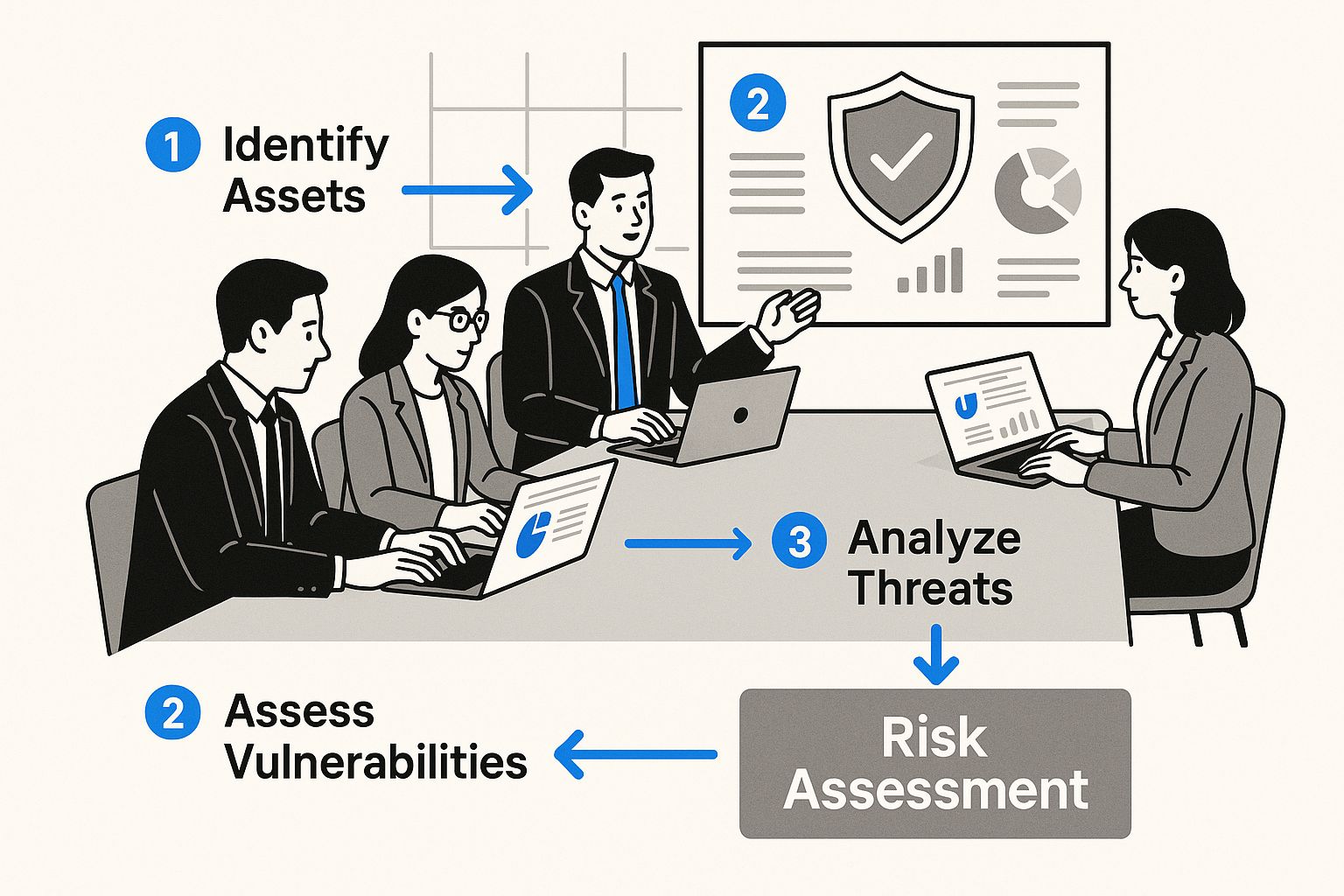
As you can see, preparation—including a solid risk assessment—is the bedrock that all other response activities are built on.
Conducting a Pre-Emptive Risk Assessment
You can't protect what you don't understand. A foundational step, long before any incident, is a thorough risk assessment. You need to identify your most valuable data assets—your "crown jewels"—and get a handle on the threats they face. This isn't a one-time thing; it's an ongoing process.
Start by mapping your data. Where does your most sensitive information live? Think customer PII, financial records, or intellectual property. Where is it stored, how is it transmitted, and who processes it? Once you know what you have, you can analyze the weak spots. Could an unpatched server be an open door? Are employee credentials really secure?
By identifying your highest-risk assets and the most likely attack vectors before something happens, you can focus your defenses where they matter most. This proactive work helps you build an initial containment playbook that’s actually tailored to your business, ensuring your response team isn't just reacting but executing a strategy built for your organization’s unique risks.
From Suspicion to Certainty: Identifying the Breach
It often starts with a whisper, not a bang. That strange alert from your monitoring tools at 2 AM. An unusual spike in outbound network traffic that just doesn’t feel right. Sometimes, it’s a tip-off from a concerned customer. This is that foggy, uncertain moment between business as usual and a full-blown crisis. How you act right now will define everything that comes next.
Your first job is to get from suspicion to certainty, and you need to do it quickly but methodically. This is absolutely not the time to panic and start yanking servers offline without a clear reason—that can do more harm than good. Instead, this is a time for careful, evidence-based investigation. A few failed login attempts from a single user is one thing; a confirmed intrusion is another beast entirely.
The reality of how breaches are found can be a tough pill to swallow. With over 3,100 incidents hitting more than 349 million victims in a recent year, these events are alarmingly common. What's more telling is that industry data shows 40% of these breaches were first spotted by external parties, not the organizations themselves. Another 27% only came to light when the attackers announced themselves with a ransomware demand. You can dig into these data breach statistics and their implications to get a clearer picture of the modern threat environment.
This highlights a hard truth: you can't just rely on your internal alarms. You have to treat external alerts with the same seriousness as your own.
The Initial Investigation and Evidence Preservation
The second you identify a credible threat, you have two critical, simultaneous goals: figure out the scope of the attack and preserve the digital evidence. They have to happen in parallel.
Think back to that anomalous outbound traffic at 2 AM. The first instinct might be to just shut it down. But doing so could tip off the attacker, causing them to erase their tracks or dig in deeper.
A much smarter approach involves a few key steps:
- Take a snapshot. The first thing you should do is create a forensic image of the compromised system. This gives you a perfect, bit-for-bit copy to investigate without touching the live machine and altering evidence.
- Dig into the logs. This is where all your preparation with robust logging pays off. Start combing through firewall logs, system event logs, and application logs, looking for unusual patterns that led up to the alert.
- Connect the dots. Look for correlations. Does the suspicious traffic line up with a new user account being created? Or a login from an unusual geographic location? Building this timeline is how you start to understand the story of the attack.
A huge part of any solid response is distinguishing the real signal from all the noise. Preserving evidence while you investigate isn't just for a potential law enforcement case—it’s absolutely essential for your own team to figure out how the attacker got in and what they touched.
Validating the Incident and Kicking Off the Response
Once your initial investigation gives you strong evidence that this isn't a false alarm, it’s time to make the call. You are officially declaring a security incident. This is the trigger that formally activates your entire data breach response plan and gets the full team in motion.
Your plan should have crystal-clear criteria for what a validated breach looks like. For instance:
- Unauthorized Access: You have confirmation that someone without permission has been inside sensitive systems or data.
- Malware on Deck: You've found ransomware, keyloggers, or other malicious code running on your network.
- Data Exfiltration: You can verify that data has been moved to an unknown or malicious destination.
Once the incident is validated, the incident coordinator takes the helm. Their first move is to bring the core response team together—your technical experts, legal counsel, communications lead, and executive leadership. The goal is no longer just investigation. You're shifting into the next phase of the plan: containment.
This kind of swift, organized escalation is what separates a controlled response from a chaotic scramble. And the evidence you so carefully preserved? That's what will guide your strategy for stopping the attack in its tracks.
Containing the Damage and Eradicating the Threat

Once you've confirmed a breach, your response plan immediately kicks into high gear. This is the moment you switch from detective work to direct action. The goal is twofold: first, stop the bleeding to contain the damage, and second, systematically eliminate the threat from your network for good.
This is where a calm, evidence-based approach is your best friend. Panic is the enemy. I’ve seen teams make critical errors in the heat of the moment, like hastily wiping servers and destroying the very forensic evidence needed to understand the attack. Your plan must guide your team to isolate the problem without making it worse.
This phase is a delicate dance between speed and precision. Responding to a security incident isn't as simple as it used to be. On average, it now takes a staggering 277 days to identify and fully contain a breach. This long "dwell time" gives attackers months to burrow deep into your systems, which is exactly why swift and decisive containment is non-negotiable. You can read more about these troubling trends in breach timelines on SentinelOne.
Immediate Containment Strategies
Your absolute first priority is to stop the attacker from causing more harm or moving deeper into your network. It's like a firefighter digging a firebreak to stop a wildfire in its tracks. A solid plan will have pre-approved, specific actions ready to go based on the type of incident.
Some of the most effective short-term tactics are:
- Isolate Compromised Systems: This is usually step one. Get affected machines off the network immediately. This could mean physically pulling the plug on a server or using network access controls to block all its traffic. You're essentially putting the infected part of your network in quarantine.
- Segment the Network: If you can't isolate specific devices right away, create temporary network segments. This can prevent an attacker who has a foothold in one area—say, on a web server—from reaching mission-critical systems like your financial databases.
- Disable Breached Accounts: The second you identify compromised user credentials, shut those accounts down. This applies to every type of account—service, admin, and standard user. It's a simple move that can lock an attacker out instantly.
Here’s a piece of hard-won advice: containment is rarely a one-shot deal. It's a dynamic, ongoing process. Attackers are smart; they often set up multiple backdoors. Your team has to be ready to contain, reassess, and contain again as you uncover more about their activities.
Eradicating the Threat Methodically
With the immediate damage stopped, it’s time to perform surgery. Eradication is the meticulous process of removing the attacker and all their tools from your environment, leaving no stone unturned. Rushing this is a recipe for disaster.
From my own experience, the biggest mistake I see is "premature cleanup." A team finds a piece of malware, deletes it, brings the system back online, and breathes a sigh of relief. Days later, the attacker walks right back in through a hidden persistence mechanism they missed. You can learn more about how to avoid these kinds of missteps by reviewing common pitfalls in data breach damage control.
True, effective eradication is built on a few non-negotiable actions:
- Rebuild from Secure Backups: Don't even try to "clean" a compromised system. It’s far too risky. The only surefire method is to wipe the machine completely and restore it from a known-good, pre-incident backup. This guarantees no attacker artifacts are left behind.
- Patch All Identified Vulnerabilities: The attacker exploited a weakness to get in. Before you even think about bringing a system back online, you must patch that vulnerability. Slam the door shut so they can't use it again.
- Reset All Credentials: You have to assume every credential on a compromised system was stolen. This means a full reset of passwords and access keys for all users and services that could possibly be affected. This is also the perfect time to enforce multi-factor authentication (MFA) if you haven't already.
- Strengthen Monitoring: As you bring the rebuilt systems back online, put them under a microscope. This heightened security monitoring will help you spot any unusual activity immediately, confirming that your eradication efforts were successful.
This combined phase of containment and eradication is without a doubt the most intense part of handling a data breach. But by following a deliberate, step-by-step process, you can confidently root out the threat and start building the foundation for a secure recovery.
Navigating Recovery and the Post-Incident Review

After the chaos of containment and eradication, it's tempting to breathe a sigh of relief. But the recovery phase is a delicate operation, not a sprint to the finish line. This isn't about just flipping the power back on; it's a methodical, secure return to business as usual.
I've seen it happen too many times: organizations rush the recovery, and it ends up costing them dearly. You've just kicked an intruder out of your house—the last thing you want is to leave a window open for them to sneak back in. This stage demands careful validation, continuous monitoring, and transparent communication.
A Secure and Staged Recovery
The bedrock of any solid recovery is restoring your systems from clean, verified backups. And I can't stress that word enough: verified. Before anything goes back online, it needs to be brought up in a secure, isolated environment—think of it as a digital sandbox.
In this controlled space, your team can:
- Confirm system integrity before it ever touches the live network.
- Validate that all security patches for the vulnerability that was exploited have been properly applied.
- Test functionality to make sure the restored system works as it should, without introducing new problems.
Only when a system gets a clean bill of health should it rejoin your production environment. And even then, your work isn't over. You need to maintain heightened security monitoring, keeping a close watch on all restored assets for any odd behavior. This vigilance is your best defense against any hidden backdoors the attacker might have left behind.
The Blameless Post-Mortem
Once things have stabilized and the immediate crisis is over, it’s time for arguably the most critical part of the entire process: the post-incident review. The goal here isn't to point fingers or assign blame. It's about uncovering the truth.
Conducting a blameless post-mortem fosters a safe environment where your team can be brutally honest about what happened without fearing punishment. This is the only way you’ll get a clear picture of what worked, what didn’t, and where the response plan itself failed.
A data breach is a painful teacher, but its lessons are invaluable. The post-incident review is where you turn a negative event into a powerful catalyst for strengthening your organization’s defenses for the future.
Throughout the incident, meticulous documentation is your best friend. To make this review truly effective, you need a detailed record of every action taken. Using a good incident report template is a great way to ensure nothing gets missed. This document will be the foundation of your review meeting.
Turning Lessons into Action
The review meeting should walk through the entire incident timeline, from the moment you detected it to the final recovery. The whole point is to come away with a list of concrete, actionable improvements.
Your final report should dig into several key questions:
- Detection: How did we find out about the breach? Could we have caught it sooner?
- Response: Did our team stick to the plan? Where did we run into unexpected roadblocks?
- Tools: Did we have the right software and systems for forensics, communication, and recovery?
- Communication: How well did we talk to our employees, customers, and regulators?
- Prevention: What specific technical, procedural, or policy changes do we need to make to stop this from happening again?
The answers to these questions become your roadmap for getting better. This process directly informs how you'll update your security measures and refine your data breach response plan, ensuring the hard-won lessons from a real attack are never wasted. Of course, the best incident is one that never happens, which is why prevention is key. You can learn more by checking out our guide on the 10 steps to prevent a data breach.
Navigating Legal Requirements and Public Communications
Once you’ve contained the immediate technical threat of a data breach, you’re staring down an equally challenging front: the legal and public relations fallout. Honestly, this is where many companies stumble. What started as a contained IT issue can quickly spiral into a full-blown legal and reputational disaster if you don't handle communications carefully.
This is why your data breach response plan absolutely must have a solid strategy for communication and compliance. Getting legal counsel involved from day one isn't just a good idea—it’s essential. They’re your guides through the complex maze of breach notification laws, which can be wildly different depending on where your customers are and what kind of data was exposed.
How to Write Breach Notifications That Actually Help
When it's time to tell people their data was compromised, your guiding principles should be clarity and honesty. You want to be helpful and build trust, not cause a panic. Ditch the dense legal jargon and overly technical details. People just need to know what happened, what information of theirs was involved, and what they can do right now to protect themselves.
A solid notification letter or email must include these key things:
- A simple, direct explanation of the incident.
- The exact types of personal data that were affected (e.g., name, email address, social security number, financial details).
- What your company is doing to fix the problem and prevent it from happening again.
- Specific, actionable steps individuals can take, like monitoring their bank accounts or placing a fraud alert with credit bureaus.
- Contact information for a real person or dedicated team who can answer their questions.
Managing your legal duties means following strict rules about sensitive data. This is particularly true if you operate internationally, where frameworks like the one covering email data protection under GDPR have very specific requirements for handling and reporting breaches involving personal information.
Taking Control of the Public Story
Beyond notifying individuals directly, you’ll likely need to make a public statement. This is your chance to get ahead of the story and control the narrative. A thoughtful, transparent statement shows you're taking the situation seriously and are committed to making it right. It’s the first step in mitigating damage to your reputation and starting the long road to rebuilding trust.
Your designated Communications Lead should coordinate all public statements. This ensures you have one consistent, unified message going out across all channels—from press releases to social media. Sticking to a single source of truth prevents conflicting reports and the kind of speculation that fuels a crisis.
How you handle yourself in the public eye will be remembered long after the technical fires are out. Acting with transparency and empathy shows respect for your customers and stakeholders, and that's what will ultimately help you weather the storm.
Answering Your Top Data Breach Response Questions
Even with the best plan in place, a real incident will always raise questions. I've been in the trenches during these events, and over the years, a few key questions come up time and time again. Let's tackle them head-on.
Okay, We Think We've Been Breached. What's the Absolute First Thing We Do?
Time is critical. The very first thing anyone should do is document the exact date and time they discovered the potential breach. Don't touch anything else yet—just note it down.
Immediately after, you need to trigger your response plan by contacting your designated incident lead. From there, the first technical move is almost always the same: isolate the affected systems. Take them offline. Disconnect them from the network. Your goal is to stop the bleeding and prevent the attacker from moving deeper into your environment.
Who Needs to Be on the "Breach A-Team"?
Putting together the right response team is half the battle. This isn't just a job for the IT department; you need a cross-functional group of experts who can act fast. In my experience, the most effective teams always include:
- IT and Security: These are your technical boots on the ground for investigation, containment, and recovery.
- Legal Counsel: They are essential for navigating the complex web of compliance and regulatory notification requirements.
- Communications/PR: You need someone who can control the narrative, both internally with employees and externally with customers and the media.
- Executive Leadership: Someone needs the authority to make the tough, and often expensive, decisions without delay.
This core team, typically led by a CISO or a dedicated Incident Coordinator, has to be ready to work at a moment's notice, day or night.
How Can We Spot a Breach Before It's Too Late?
Early detection is all about knowing what "normal" looks like on your network so you can spot the abnormal. Pay close attention to things like unusual outbound traffic, a sudden surge in failed login attempts from a single account, or an admin account being used at 3 AM.
Modern security tools are a huge help here, as they use analytics to find subtle clues you might otherwise miss. But don't get complacent.
A common mistake is thinking you'll always be the one to find the breach. Often, the first alert comes from an outside party telling you they found your data somewhere it shouldn't be. If you get a notice that your own data was part of a breach, you need to act fast. You can learn more by checking out these 8 steps to take after receiving a data breach notice.
How Often Should We Dust Off and Review This Plan?
Think of your response plan as a living document, not a binder that collects dust on a shelf. You should be formally reviewing it at least once a year.
But you also need to update it any time there's a significant change in your business—like moving to a new cloud platform, a major team restructuring, or when a new type of cyberattack starts making headlines. And, of course, the most important review happens after an actual incident. That's when you can incorporate the real, hard-won lessons into your plan to make it even stronger.
At InfoTech Enterprise Solutions, we provide the proactive cybersecurity defenses and business continuity planning that form the bedrock of a strong security posture. Our managed IT services help Utah businesses secure their data and prepare for any eventuality. Get a free network assessment today.


Leave a Reply