The real heart of the outsourcing vs. in-house debate comes down to a single, critical question: Are you looking to build a long-term internal asset, or do you need immediate operational agility and efficiency? An in-house team gives you dedicated control and a team that lives and breathes your company culture. Outsourcing, on the other hand, often delivers significant cost savings and instant access to highly specialized talent.
Your choice here isn't just a line item on a budget; it's a strategic decision that will shape how your business operates for years to come.
Understanding the Fundamental Trade-Offs
Deciding between hiring your own IT team and partnering with an external provider is one of the most consequential choices a leader can make. This decision directly impacts your cost structure, of course, but it also defines your company's capacity to innovate, scale, and pivot when the market demands it. It’s less about who does the work and more about weaving a specific operational philosophy into the DNA of your company.
An in-house team is an investment in your people. You’re taking on the full costs—salaries, benefits, continuous training, and the necessary infrastructure. The return on that investment is a group of employees completely immersed in your company culture. They understand your long-term vision and accumulate invaluable institutional knowledge that can't be easily replicated.
Outsourcing flips that script. It transforms a fixed capital expense into a flexible, operational one. You pay for a service, not an employee. This opens the door to a global talent pool and specialized skills that might be too expensive or difficult to recruit and retain on your own.
The global outsourcing market is booming for a reason, projected to hit $450 billion by the end of 2025. While 57% of executives point to cost reduction as the primary driver, gaining access to specialized expertise is right behind it. You can explore more outsourcing statistics and trends to see the full picture.
To help frame your thinking, let's start with a high-level look at how these two models stack up against each other.
At a Glance Outsourcing vs In-House
This table provides a quick summary of the key differences you'll find when comparing outsourcing to building an in-house team.
| Factor | Outsourcing | In-House |
|---|---|---|
| Cost Structure | Variable, predictable operational expense (OpEx) with lower upfront investment. | Fixed capital expense (CapEx) including salaries, benefits, and infrastructure. |
| Talent Access | Access to a broad, global pool of specialized experts on demand. | Limited to local talent pool and requires significant recruitment efforts. |
| Scalability | High flexibility to scale resources up or down quickly based on project needs. | Scaling is slower and more expensive, tied to hiring and training cycles. |
| Control & Culture | Less direct control; cultural integration can be a challenge. | Full control over operations, processes, and fostering a cohesive team culture. |
While this table gives you the basics, the right choice always depends on your specific business goals, resources, and priorities. Each factor carries a different weight for every organization.
Aligning Your Team Model with Business Strategy

Deciding between outsourcing and building an in-house IT team isn't just an operational headache—it's a core strategic choice that will absolutely define your company's competitive edge. The right model has to sync up with your long-term business goals, whether you’re focused on aggressive market penetration, groundbreaking product innovation, or nurturing deep customer relationships. How you handle your IT shapes how you build value.
For some businesses, the entire strategy is built around developing deep, proprietary knowledge. In this case, an in-house team becomes your crown jewel. They accumulate expertise and build a cohesive culture that truly gets the nuances of your products and customers. This approach is incredibly powerful when your secret sauce is directly tied to internal know-how and a unified team vision.
Building Assets Versus Gaining Advantages
Think of an in-house team as an investment in a long-term, internal asset. As the team's understanding of your business deepens over time, they become a powerful engine for continuous innovation and genuine product ownership. Every project they tackle adds to a cumulative knowledge base that competitors will find nearly impossible to replicate.
Outsourcing, on the other hand, is a tactical play. It's about gaining an immediate advantage by tapping into specialized skills and global talent without the long-term overhead of hiring. This is the perfect move when speed-to-market is everything or when you need niche expertise for one critical project. A classic example is bringing in an outsourced team to quickly build a mobile app while your core team stays focused on the main product.
A company's choice of team model is a direct reflection of its strategic priorities. Building an internal team signals a commitment to cultivating deep, long-term expertise, while outsourcing demonstrates a focus on agile, on-demand innovation and operational efficiency.
This strategic split is clear in market trends. Business process outsourcing (BPO) and IT outsourcing are huge economic forces, with the BPO market expected to reach $525 billion by 2030. It’s telling that 92% of Global 2000 companies use IT outsourcing, and 37% of small businesses outsource at least one business process, which shows just how wide its strategic appeal is. You can discover more insights about these outsourcing statistics.
Matching Your Model to Your Market
Where you are in your business journey should heavily influence this decision. A scrappy startup racing to launch a minimum viable product (MVP) has completely different needs than an established enterprise managing a web of complex legacy systems. The startup will benefit immensely from the speed and lower upfront cost of an outsourced team.
The established enterprise, however, often needs the deep institutional knowledge that only a dedicated in-house team can really offer. Many businesses find a hybrid approach works well, outsourcing specific functions like IT helpdesk or cybersecurity to free up their internal experts for high-value strategic initiatives. Small businesses, in particular, can see huge benefits from outsourced cloud management. To learn more, check out our guide on how to maximize cloud solutions for your small business.
In the end, the best answer to the outsourcing vs in-house debate comes down to a simple question: does your strategy demand deep-rooted, proprietary expertise, or does it call for agile, on-demand innovation?
A Nuanced Comparison of Key Decision Factors
When you get down to brass tacks, the choice between outsourcing and building an in-house team really comes down to a few critical factors. Moving beyond theory, you need to take a hard look at the real-world impact on your costs, control, security, and ability to scale. This isn't just about a simple list of pros and cons; it's about understanding the specific trade-offs each path forces you to make.
The Financial Reality: OpEx vs. CapEx
Let's start where most businesses do: the budget. The financial piece of the outsourcing vs in-house puzzle is a classic battle of operational expenses (OpEx) versus capital expenses (CapEx).
An in-house team is a major capital investment. You’re not just paying salaries; you're on the hook for benefits, office space, hardware, software, and ongoing training. A huge part of this initial outlay is simply finding the right people. Learning how to reduce recruitment costs is essential if you're even considering this route. Outsourcing flips this model on its head, turning a massive upfront cost into a predictable monthly fee that makes budgeting far simpler.
This visual gives a great snapshot of how the costs and timelines typically stack up.
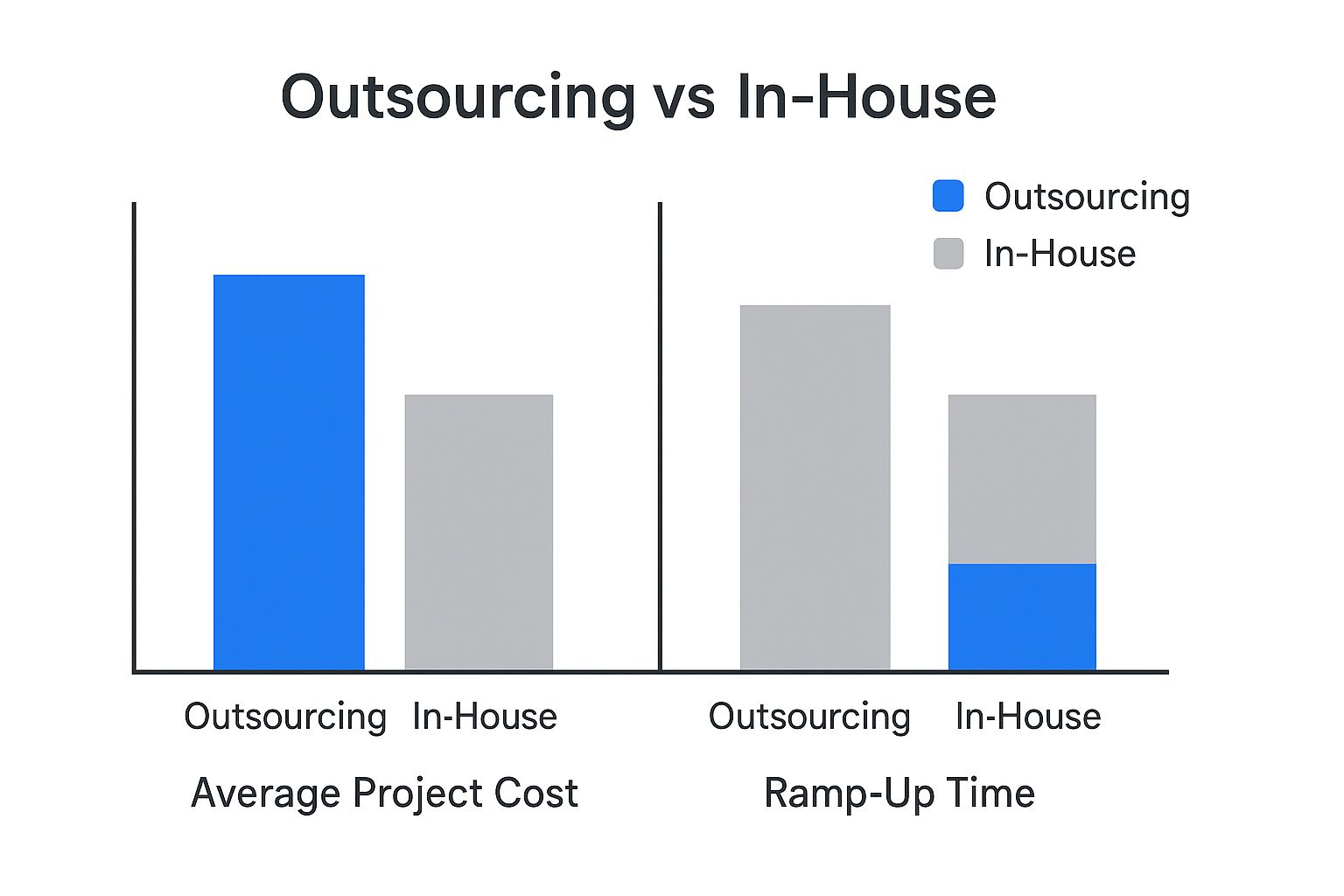
As you can see, outsourcing almost always has a lower barrier to entry financially and gets you up and running much faster by cutting out the long, drawn-out process of hiring and training.
To really dig into these differences, let's break them down factor by factor.
Detailed Factor Analysis: Outsourcing vs In-House
This table provides a more granular look at how each model stacks up against the most important business and operational criteria.
| Criterion | Outsourcing Analysis | In-House Analysis |
|---|---|---|
| Cost Structure | Primarily OpEx (Operational Expense). You pay a recurring fee, which is great for budget predictability and avoids large upfront investments. | Primarily CapEx (Capital Expense) initially. Involves high upfront costs for recruitment, salaries, benefits, equipment, and office space. |
| Control | You have control over the outcome. The focus is on Service Level Agreements (SLAs) and defined deliverables. The "how" is left to the expert vendor. | You have direct control over the process. You dictate daily tasks, workflows, and can pivot team priorities on a dime. |
| Security | Security is managed through contractual obligations and the provider's expertise. Often, they have access to enterprise-grade security tools you couldn't afford. | Security is managed entirely within your own infrastructure. You have full control, but also the full burden of keeping up with evolving threats. |
| Scalability | High. You can scale your team up or down very quickly based on project needs, paying only for the resources you're actively using. | Low. Scaling is a slow, expensive process tied to hiring and onboarding new employees. Responding to sudden demand is difficult. |
| Talent Access | You gain immediate access to a global talent pool, including highly specialized skills that may be difficult or impossible to find locally. | You are limited to the local talent pool or your ability to attract remote employees. Competition for top talent can be fierce and expensive. |
| Time-to-Market | Fast. Teams are pre-assembled and ready to start on your project almost immediately, significantly shortening development cycles. | Slow. The process from identifying a need to having a fully productive team can take months due to recruiting, interviewing, and onboarding. |
Ultimately, neither model is inherently superior; the "better" choice is completely dependent on your company's specific situation, priorities, and long-term goals.
Control and Communication Dynamics
Control is a big one for many leaders. An in-house team gives you that hands-on, direct oversight. You can walk over to someone's desk, have impromptu brainstorming sessions, and know that everyone is steeped in your company's unique culture. This is invaluable for projects that are highly sensitive or require constant, subtle adjustments.
Outsourcing, by its nature, introduces a bit of distance. While tools like Slack, Jira, and regular video calls have made this gap much smaller, you do give up some of that moment-to-moment control. The key here is a mental shift. You have to move from managing people directly to managing outcomes defined in a service-level agreement (SLA).
Think of it this way: An in-house team gives you process control, letting you dictate how the work gets done. Outsourcing gives you outcome control, where you define what you need and trust the experts to figure out the best way to deliver it.
This change in perspective is non-negotiable for a successful partnership. It all boils down to trust and having an incredibly well-defined scope from the very beginning.
Security and Risk Management
On the security front, the trade-offs are just as distinct. With an in-house team, everything happens within your four walls (or your private cloud). You control the network, the data access, and the compliance protocols. There's a certain comfort in knowing all your sensitive information is under your direct lock and key.
The flip side is that the entire burden of cybersecurity—a relentlessly evolving field—falls squarely on your shoulders. Can your team keep up? Outsourced IT providers, particularly managed service partners, live and breathe security. They often have dedicated security operations centers and invest in sophisticated tools that most small or mid-sized businesses could never justify buying themselves. The risk isn't gone; it's managed through ironclad contracts, compliance certifications, and strict data protection policies.
Scalability and Talent Acquisition
For many businesses, the need for agility is what makes this decision for them. Scaling an in-house team is a slow, expensive ordeal. If you land a huge project and need to double your IT capacity for the next three months, an internal model just isn't built to react that quickly.
This is where outsourcing shines. It offers almost on-demand scalability. Need more developers? You can have them next week. Project winding down? You can scale back just as easily, paying only for what you use. This flexibility is a massive advantage in today's unpredictable market.
It also provides a direct answer to the chronic headache of finding good people. With the global IT outsourcing market expected to hit around $591.24 billion by 2029, it’s clear that companies are turning to it to solve the talent shortage. Recruiters consistently report how hard it is to find qualified IT professionals, making outsourcing an essential strategy for accessing specialized skills without enduring a painful, months-long hiring search. This means the outsourcing vs in-house decision isn't just about money—it's about getting the talent you need to stay competitive.
When to Choose Each Approach: Real-World Scenarios

The whole outsourcing vs. in-house debate can feel a bit abstract. But when you apply it to actual business problems, the right answer becomes much clearer. There's no single best choice—it all comes down to your specific situation.
Let's walk through a few common scenarios. By seeing how other businesses make this call, you can get a better handle on which path makes sense for you.
When Outsourcing Is the Smart Move
Sometimes, speed, specialized skills, or a tight budget are the most important factors. This is where outsourcing really shines. It gives you immediate access to expert talent and resources without the long-term overhead of hiring.
Here are a few times when bringing in an outside team is the strategic winner:
- The Startup MVP: A new tech company needs to get its minimum viable product (MVP) to market fast to test the waters and attract investors. Outsourcing development to a firm that lives and breathes this stuff can shrink the timeline from many months down to just a few weeks. You can see a great example of this in action in this case study on a training platform.
- The One-Off Specialized Project: A manufacturing firm wants to build a new AI-powered inventory system. Instead of trying to find and hire expensive AI specialists for a single project, they can outsource it to a company that already has a proven track record in that exact niche.
- Non-Core Business Functions: A busy law firm’s administrative staff is getting bogged down with IT support requests, network maintenance, and security patches. By handing over their IT management to a managed services provider (MSP), they let their team get back to focusing on clients, not fixing tech problems.
The real art of outsourcing is using it to handle tasks that are essential for your business but aren't part of your core mission. It frees up your best people to focus on what makes your company unique.
When an In-House Team Is a Necessity
On the other hand, some situations absolutely demand the control, cultural fit, and deep-seated knowledge that only an in-house team can provide. When the work is tied directly to your company's secret sauce or long-term vision, keeping it internal is often the only way to go.
An in-house team is the clear choice in these situations:
- Managing Proprietary Technology: Think of a fintech firm whose entire business is built on a complex, confidential trading algorithm. Keeping its development in-house is non-negotiable. It protects their intellectual property and ensures the team has a deep, evolving understanding of how it all works.
- Deep Integration with Legacy Systems: A hospital needs to upgrade its patient records software, but it has to connect perfectly with dozens of old, quirky legacy systems. An in-house team that has spent years working with those very systems is in the best position to manage such a delicate and critical project.
- Building a Strong, Unified Culture: Imagine a company that prides itself on a very specific, high-touch customer service style. Its IT support has to embody that same ethos in every single interaction. An in-house team can be steeped in the company’s values in a way that’s incredibly difficult to achieve with an outside partner.
Deciding to hand over a complex function like IT is a significant move. If you're leaning toward outsourcing, learning how to vet and select the right partner is crucial. You can find out more by reading our guide on https://infotech.net/blog/what-is-an-msp-and-how-to-choose-the-right-one-for-your-business/. Ultimately, the right decision always comes back to your specific goals and circumstances.
Making Your Final Decision: A Practical Framework
Moving from analysis to a confident decision means you have to look past the simple "outsourcing vs. in-house" debate. In my experience, the best choice is rarely a clear-cut, either/or scenario. It’s about taking an honest look at your company's real-world needs, risk appetite, and long-term goals.
A great way to start is by getting your leadership team together and asking a few tough questions. The answers will quickly steer you toward the model that makes the most sense for where your business is right now.
Key Self-Assessment Questions
- Fixed vs. Variable Costs: Can we handle a significant upfront capital investment for an in-house team? Or does a predictable, recurring operational cost from outsourcing fit our budget better?
- Speed-to-Market: How fast do we need to move on our current projects? Is it critical to have a team delivering results in a few weeks, or can we afford the months it might take to recruit, hire, and train?
- Core Competency: Is this particular IT function a secret sauce—something that makes our business unique? Or is it a standard, necessary operation that just needs to run smoothly?
- Risk and Continuity: What would happen to our projects if a key member of our internal team left unexpectedly? Every business needs a solid backup plan. In fact, having a continuity plan is a sign of great leadership.
When you answer these questions honestly, a common realization emerges: neither a 100% in-house nor a 100% outsourced model is the perfect solution. And that's okay. It's what opens the door to a smarter, more flexible strategy.
Introducing the Hybrid Model
The hybrid model isn’t a compromise; it's a strategic move. It's all about blending your own in-house staff with external partners to build a custom team that leverages the best of both worlds. This approach has become incredibly popular because it’s so effective for businesses of all sizes.
For instance, you might keep your core product development team in-house to guard your intellectual property and retain that deep, irreplaceable company knowledge. At the same time, you could outsource cybersecurity, cloud infrastructure management, and IT helpdesk support to a specialized Managed Services Provider (MSP).
The hybrid model allows a company to retain direct control over its most strategic assets while gaining the cost efficiency, specialized expertise, and scalability of outsourcing for non-core functions. It’s about architecting a team, not just choosing one.
This gives you an incredible advantage. Your internal experts are no longer bogged down by routine maintenance. Instead, they can focus their energy on high-impact projects that actually grow the business. Meanwhile, your outsourced partner handles the essential but time-consuming tasks with an efficiency and level of expertise that would be difficult and expensive to build from scratch.
Once you’ve decided which functions to hand off, the next step is finding the right partner. Getting practical advice on how to successfully outsource a development team can make all the difference during this critical phase.
Frequently Asked Questions
Once you've weighed the strategic, financial, and operational pros and cons, you'll likely have some practical questions. That's a good sign. Moving from analysis to a confident decision means getting into the nitty-gritty. This FAQ is designed to tackle those common concerns head-on.
Is Outsourcing Only for Large Companies?
There’s a persistent myth that only big corporations with deep pockets can afford to outsource. The reality is quite different. Modern managed IT services are built to scale, making them a fantastic option for small and medium-sized businesses (SMBs). Many providers offer flexible, tiered pricing that gives you access to enterprise-level expertise for a predictable fee—often less than the cost of one full-time hire.
For an SMB, this can be a game-changer. Instead of stretching the budget to hire a single IT generalist who has to know a little bit of everything, you get a whole team of specialists in cybersecurity, network management, and cloud services. It levels the playing field.
How Can I Ensure Quality and Maintain Control?
The thought of handing over the keys to your IT can be unnerving. It's a valid concern, but effective control isn't about micromanaging daily tasks; it's about managing outcomes. The secret is to build a solid framework right from the beginning.
Here’s how you can guarantee quality without looking over their shoulder:
- Establish Clear Key Performance Indicators (KPIs): Your Service Level Agreement (SLA) should spell out your expectations. Define measurable goals for system uptime, ticket response times, and project deadlines.
- Use Shared Project Management Tools: Platforms like Jira, Asana, or Trello give you a real-time window into what's being worked on and where things stand.
- Set a Communication Cadence: Regular check-ins are crucial. Whether it's a quick daily stand-up or a more detailed weekly review, consistent communication keeps everyone aligned and lets you tackle issues before they become problems.
This is about shifting your mindset from managing processes to managing results. You don't need to dictate how the work gets done, but you must be crystal clear about what needs to be delivered and when.
What Are the Biggest Hidden Costs of an In-House Team?
When you think about hiring an in-house employee, salary is the first number that comes to mind. But that's just the tip of the iceberg. The true cost of an employee is often 25% to 40% higher than their base salary. These hidden expenses can completely change the math in the outsourcing vs. in-house debate.
Look beyond the paycheck and you'll find costs for:
- Recruiting and Onboarding: Think job postings, the time your team spends interviewing, and the ramp-up period for training.
- Benefits and Taxes: Health insurance, retirement contributions, and payroll taxes are major, recurring expenses.
- Tools and Infrastructure: Every employee needs a computer, software licenses, and a place to sit.
- Continuous Training: Technology never stands still. To keep your team's skills sharp, you have to invest in ongoing professional development.
When you add it all up, the financial gap between hiring in-house and partnering with a managed service provider is often much wider than a simple salary-to-fee comparison suggests.
At InfoTech Enterprise Solutions, we believe in predictable pricing without the surprise fees. Our all-inclusive managed IT model gives you access to a full team of experts for one clear monthly cost, so you can stop worrying about IT and focus on what you do best. Discover how our managed IT services can streamline your operations today.


Leave a Reply