In today's volatile landscape, a disruption isn't a matter of 'if,' but 'when.' From cyberattacks and supply chain failures to natural disasters, the threats facing your business are more complex than ever. Waiting for a crisis to strike is no longer a viable strategy. A robust, well-documented business continuity plan (BCP) is the critical framework that separates businesses that falter from those that emerge stronger. However, creating a BCP can feel overwhelming. Where do you even begin?
The answer lies in a structured, actionable approach. This comprehensive business continuity plan checklist breaks down the process into seven manageable, critical components. We will move beyond generic advice to provide detailed, implementation-focused steps, real-world examples, and expert insights tailored for organizations from healthcare practices to manufacturing firms. By following this guide, you can methodically build a resilient organization capable of weathering any storm and protecting your people, processes, and profits.
This checklist is designed to transform a daunting task into a series of clear, executable actions. Each item builds upon the last, creating a holistic defense against operational interruptions. Understanding the foundational power of checklists is a key first step; to expand on this principle for more general situations, you can consult an ultimate emergency preparedness checklist that covers broader safety measures. Our focus here, however, is on maintaining your core business functions. Let’s dive into the essential steps for building your plan.
1. Business Impact Analysis (BIA)
A Business Impact Analysis (BIA) is the foundational first step in any robust business continuity plan checklist. It’s a systematic process used to identify and evaluate the potential effects of an interruption to your critical business operations. Think of it as the diagnostic phase before you write the prescription; it helps you understand which parts of your business are most vital and how quickly they need to be restored to avoid catastrophic damage.
The BIA determines recovery priorities by analyzing the financial, operational, and reputational impact of disruptions over specific time periods. It answers crucial questions like: "If our customer relationship management (CRM) system goes down, how much revenue do we lose per hour?" or "If our main production line halts, what are the cascading effects on our supply chain and client commitments?"
How a BIA Works in Practice
Executing a BIA involves gathering data from across your organization to quantify the consequences of a disruption. This isn't a task for the IT department alone; it requires collaborative input from every business unit.
- Financial Impact: This includes direct losses like lost sales and revenue, as well as indirect costs such as penalties for non-compliance, contractual fines, or overtime wages needed for recovery.
- Operational Impact: This covers the disruption to your daily workflow, production delays, and your inability to deliver services or products to customers.
- Reputational Impact: This assesses damage to customer confidence, brand image, and your standing within the industry.
For example, a hospital system’s BIA would immediately prioritize life-critical functions like patient monitoring systems over administrative tasks like billing. Similarly, Amazon’s BIA for its AWS cloud services must consider the immense cascading impact a single service outage has on the millions of businesses that depend on it.
Key Insight: A BIA transforms business continuity from a vague concept into a data-driven strategy. It replaces guesswork with a clear, prioritized roadmap, ensuring you focus recovery efforts where they matter most.
Actionable Tips for a Successful BIA
To ensure your BIA is comprehensive and accurate, follow these practical steps:
- Involve Department Heads: Conduct structured interviews or workshops with leaders from every department (sales, operations, finance, HR) to get a complete picture of operational dependencies.
- Use Tiered Impact Categories: Classify business functions into tiers like Critical, High, Medium, and Low. This helps prioritize recovery efforts and allocate resources effectively.
- Document Recovery Objectives: For each critical function, define two key metrics:
- Recovery Time Objective (RTO): The maximum acceptable time a system or function can be down.
- Recovery Point Objective (RPO): The maximum acceptable amount of data loss, measured in time (e.g., 15 minutes of data).
- Review and Update Annually: Your business isn’t static, and neither is its risk profile. Revisit your BIA annually or after any significant change, such as launching a new product line or opening a new location.
The following graphic summarizes the core outputs of a well-executed BIA, highlighting the key metrics that guide your recovery strategy.
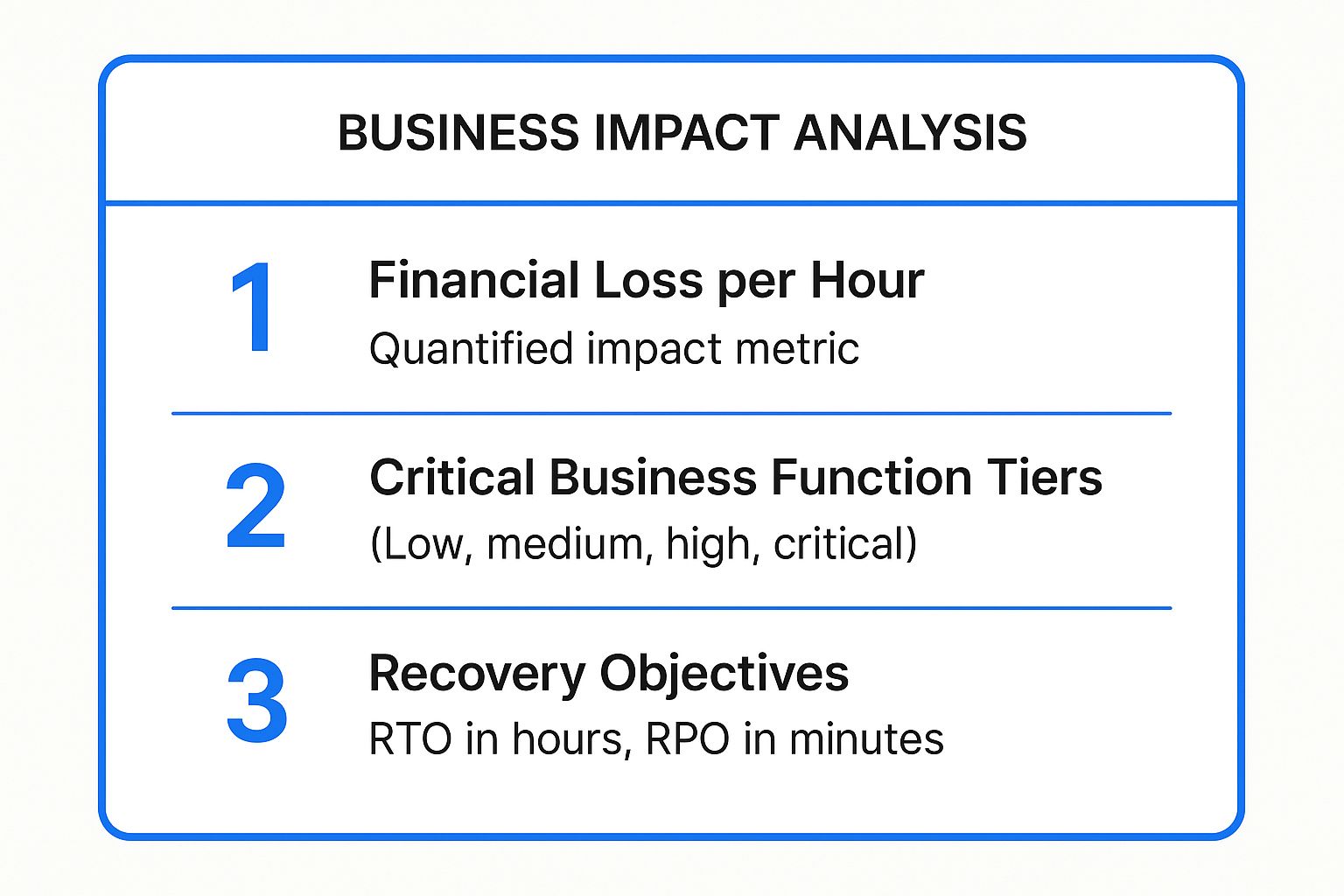
This visual breakdown clearly links financial risk to tiered functions and sets concrete recovery targets, forming the essential data-driven backbone of your business continuity plan.
2. Risk Assessment and Threat Identification
Following the BIA, a comprehensive Risk Assessment and Threat Identification process is the next critical component in a business continuity plan checklist. While the BIA identifies what is critical to your business, a risk assessment determines what could harm those critical functions. It is a systematic process of identifying, analyzing, and evaluating potential threats and vulnerabilities that could disrupt your operations.
This step moves from internal analysis to an external and internal threat-based perspective. It's designed to answer questions like: "What is the likelihood of a major earthquake impacting our headquarters?" or "How vulnerable are our systems to a sophisticated ransomware attack?" By cataloging potential disruptions from natural disasters to human-caused incidents, you can develop targeted strategies to mitigate, transfer, or accept these risks.
How a Risk Assessment Works in Practice
Executing a thorough risk assessment involves a broad environmental scan to identify all plausible threats and a deep internal review to find vulnerabilities. This process is guided by frameworks like ISO 31000 and requires input from operational, IT, and security teams.
- Threat Identification: This involves cataloging all potential hazards. This includes natural disasters (floods, wildfires), technological failures (power outages, system crashes), human-caused events (theft, terrorism), and even public health emergencies. Your risk assessment should comprehensively identify all potential threats, from natural disasters to cyberattacks, and even public health emergencies. Understanding the nature and impact of threats like common virus infections is essential for effective planning.
- Vulnerability Analysis: This evaluates weaknesses that could be exploited by a threat. For example, a vulnerability could be an unpatched server, a single-source supplier, or a facility located in a flood-prone area.
- Impact and Likelihood Evaluation: Each identified risk is scored based on its potential impact (quantified by the BIA) and its likelihood of occurrence. This creates a prioritized list of risks that demand immediate attention.
For instance, after the 2011 tsunami disrupted its supply chain, Toyota conducted an extensive risk assessment, leading to supplier diversification and a more resilient production model. Similarly, the 2021 Colonial Pipeline ransomware attack forced energy companies to reassess their cybersecurity posture, highlighting the immense operational risk posed by cyber threats.
Key Insight: A risk assessment provides the context for your BIA findings. It connects your critical business functions to real-world threats, allowing you to build proactive and relevant recovery strategies instead of generic, one-size-fits-all plans.
Actionable Tips for a Successful Risk Assessment
To ensure your risk assessment is comprehensive and actionable, follow these practical steps:
- Use a Hybrid Approach: Combine quantitative analysis (assigning numerical values to risk) with qualitative analysis (categorizing risks as High, Medium, Low). This balances data-driven precision with expert judgment.
- Create Risk Heat Maps: Visualize your risks on a matrix that plots likelihood against impact. This makes it easy for stakeholders to quickly understand the most significant threats and prioritize mitigation efforts.
- Engage External Experts: For specialized areas like cybersecurity or geopolitical risk, consider bringing in consultants who can provide valuable threat intelligence and an objective perspective.
- Establish Risk Tolerance: Define your organization’s willingness to accept risk. This threshold will guide decision-making on whether to invest in mitigation controls or accept a particular risk.
- Include Emerging Threats: Don’t limit your assessment to known risks. Proactively consider emerging threats such as climate change, advanced AI-driven cyberattacks, and global supply chain volatility.
3. Communication Plan and Emergency Notifications
When a crisis strikes, technology and processes are only part of the solution; how you communicate determines whether stakeholders remain calm and confident or descend into confusion and panic. A Communication Plan and Emergency Notification system is the structured framework for managing the flow of information during a disruption. It ensures that everyone from employees and customers to suppliers and regulators receives timely, accurate, and consistent updates.
This critical component of your business continuity plan checklist moves beyond a simple contact list. It defines who needs to be told what, when, and through which channels. It prepares you to manage the narrative, prevent misinformation, and maintain trust when it matters most. During a disruption, silence is often interpreted as incompetence or, worse, indifference. A well-executed communication plan demonstrates control and care.

How a Communication Plan Works in Practice
A communication plan is a pre-approved playbook that activates the moment an incident is declared. It outlines specific procedures for both internal and external audiences, ensuring no one is left in the dark.
- Internal Communications: This focuses on keeping your team safe and informed. It includes instructions on what to do, where to go (or work from), and when to expect the next update. This prevents internal rumors and empowers employees to be brand ambassadors.
- External Communications: This manages perceptions among customers, partners, investors, and the public. It provides clear information about service impacts, recovery timelines, and what the company is doing to resolve the issue.
- Multi-Channel Strategy: The plan leverages multiple channels like SMS alerts, email blasts, automated phone calls, a dedicated status page on your website, and social media updates to ensure messages get through even if one channel fails.
For example, Microsoft's response to major Azure outages includes a publicly accessible status dashboard that provides real-time updates and detailed post-incident reports. This transparency, guided by a pre-set communication protocol, helps maintain trust with its global customer base. Similarly, Johnson & Johnson’s textbook crisis communication during product recalls involved swift, honest public statements and clear instructions, preserving long-term brand equity.
Key Insight: In a crisis, effective communication is a strategic asset, not an administrative task. It prevents a manageable operational incident from escalating into a catastrophic reputational disaster.
Actionable Tips for a Successful Communication Plan
To build a communication plan that holds up under pressure, follow these practical steps:
- Prepare Message Templates: Draft pre-approved message templates for various scenarios (e.g., system outage, data breach, facility closure). This saves critical time and prevents rushed, error-prone communications during an actual event.
- Maintain Redundant Contact Databases: Keep updated contact lists for all stakeholders on multiple, separately hosted platforms (e.g., a cloud CRM and an offline spreadsheet). This ensures you can reach people even if your primary system is down.
- Establish a Clear Hierarchy: Define a clear chain of command for communication authority. Designate and train official spokespersons to ensure a single, consistent voice and message discipline.
- Incorporate Social Media Protocols: Include specific guidelines for monitoring social media channels and responding to inquiries and misinformation. Designate team members to manage this in real time.
- Test Notification Systems Regularly: Don’t wait for a real disaster. Conduct monthly or quarterly tests of your notification systems using different scenarios to work out any kinks and ensure the technology works as expected.
4. Data Backup and Recovery Procedures
While a Business Impact Analysis tells you what to protect, Data Backup and Recovery Procedures are the technical blueprint for how you protect and restore your most valuable asset: your information. These procedures are the critical, hands-on instructions that ensure your business-critical data can be recovered swiftly and accurately after a disruption, whether it's a hardware failure, cyberattack, or natural disaster. Without them, your entire business continuity plan is theoretical.
These procedures define the entire lifecycle of your data protection strategy. They dictate how frequently backups are taken, where they are stored, who is authorized to access them, and the exact steps required to restore systems to operational status. This isn't just about having copies of files; it's about guaranteeing data integrity, security, and accessibility when you need it most.

How Data Backup and Recovery Works in Practice
Executing a data backup and recovery strategy involves more than just plugging in an external hard drive. It's a multi-layered defense system tailored to your specific RTO and RPO targets.
- Backup Scheduling and Frequency: This determines how often data is copied, ranging from continuous real-time replication for critical databases to daily or weekly backups for less dynamic information.
- Storage Methods and Locations: This outlines where backups are stored. A robust strategy uses a mix of local storage for fast restores and cloud or offsite storage for disaster recovery.
- Recovery Testing: This is the crucial step of regularly simulating a failure to verify that your backups are functional and your team can execute the recovery plan within the established RTO.
- Data Integrity Verification: This involves processes to check for corruption or errors in backed-up data, ensuring that what you restore is accurate and usable.
For example, GitLab’s well-documented 2017 incident, where an engineer accidentally deleted a production database, became a powerful real-world lesson. Their transparent recovery process highlighted the immense value of having multiple, tested backup systems in place. Similarly, Netflix's "Chaos Monkey" proactively tests system resiliency by randomly disabling production instances, forcing its engineers to build highly resilient backup and failover mechanisms.
Key Insight: Data backup is an insurance policy; data recovery is the claims process. A successful strategy requires you to not only pay the premium (backing up) but also to practice the claim (recovering) to ensure it works when you need it.
Actionable Tips for a Successful Backup Strategy
To build a resilient and reliable data protection system, integrate these best practices into your business continuity plan checklist:
- Follow the 3-2-1 Backup Rule: Maintain 3 copies of your data on 2 different types of media, with at least 1 copy stored offsite. This provides redundancy against multiple failure scenarios. You can discover more by reviewing these best practices for secure data backup on infotech.net.
- Test Recovery Procedures Quarterly: Don’t wait for a disaster to find out your backups are corrupted. Conduct quarterly tests with realistic scenarios, such as restoring a critical server or a specific database, to validate your process and train your team.
- Document Step-by-Step Recovery Guides: Create clear, detailed documentation for recovering different systems. This guide should be accessible even if your primary network is down (e.g., a printed copy in a secure offsite location and a cloud-hosted version).
- Implement Cloud-Based Solutions: Consider modern cloud backup solutions (BaaS) for their scalability, geographic redundancy, and simplified management. They can automatically handle offsite storage and often provide robust security features.
The following video from VMware provides an excellent overview of disaster recovery concepts, which are intrinsically linked to backup procedures.
By implementing and regularly validating these procedures, you transform data backup from a passive task into an active, strategic defense for your organization.
5. Alternate Work Locations and Remote Operations
An alternate work location strategy is a critical component of a modern business continuity plan checklist, ensuring your operations can continue even when your primary facilities are inaccessible. This involves establishing the plans, policies, and technological infrastructure necessary for your team to work effectively from alternative sites. It moves beyond a simple "work from home" policy into a structured, resilient framework for distributed operations.
This strategy addresses the physical component of a disaster. Whether a fire, flood, power outage, or public health crisis makes your office unusable, having a pre-planned alternative ensures your business doesn’t grind to a halt. It answers the fundamental question: "If we can't get into the office, where and how do we keep working?" The goal is to maintain productivity, serve customers, and protect revenue streams without missing a beat.
How Alternate Work Locations Work in Practice
Implementing this strategy involves creating a multi-faceted plan that covers various scenarios. This is not a one-size-fits-all solution; it requires a blend of technology, policy, and logistics tailored to your specific business needs.
- Remote Work Capabilities: This is the most common approach, where employees use secure connections to access company systems and data from their homes. This requires robust VPNs, cloud-based applications, and clear communication protocols.
- Backup Office Space: For functions that cannot be performed remotely, companies may contract with providers for "hot sites" (fully equipped offices) or "cold sites" (empty spaces with power and connectivity) that can be activated during an emergency.
- Mobile Operations: Some businesses, particularly in logistics or field services, may deploy mobile command centers or vehicles equipped with the necessary technology to manage operations on the go.
For instance, after the COVID-19 pandemic, companies like Salesforce institutionalized a "Work From Anywhere" model, proving that large-scale remote work is viable with the right infrastructure. Similarly, financial institutions like JP Morgan Chase maintain fully operational backup trading floors in different geographic locations to ensure seamless market activity during a regional disruption.
Key Insight: An alternate work location plan is not just about technology; it’s a business-wide operational pivot. Success depends on empowering your people with the right tools, policies, and security measures to be productive from anywhere.
Actionable Tips for a Successful Strategy
To build a resilient and effective alternate location plan, consider these practical steps:
- Establish Co-Working Partnerships: Form agreements with co-working spaces or shared office providers to secure overflow capacity or temporary hot desks for key personnel.
- Implement a Zero-Trust Security Model: For remote access, assume no user or device is inherently trustworthy. A zero-trust framework requires strict verification for every person and device attempting to access resources, which is essential for protecting your network. Learn more about the essential security practices for remote workers to strengthen your digital defenses.
- Standardize Home Office Setups: Provide or subsidize ergonomic equipment like chairs, monitors, and keyboards to ensure employee health, comfort, and productivity during extended remote work periods.
- Test Capabilities Regularly: Don’t wait for a disaster. Conduct planned drills where entire departments or the whole company works remotely for a day to identify and resolve technological or logistical bottlenecks.
6. Supply Chain and Vendor Management
A modern business is rarely an island; it's an interconnected ecosystem heavily reliant on external suppliers and vendors. Effective supply chain and vendor management is a critical component of any business continuity plan checklist, as a disruption to just one key partner can bring your entire operation to a standstill. This process involves identifying, assessing, and mitigating risks associated with the third parties that provide you with essential goods and services.
This element of your plan addresses the "what if" scenarios beyond your four walls. It asks critical questions like, "What happens if our primary raw material supplier is shut down by a natural disaster?" or "How do we operate if our logistics partner experiences a major cyberattack?" Proactively managing these dependencies ensures that external disruptions have a minimal impact on your ability to serve your customers and maintain operations.
How Supply Chain and Vendor Management Works in Practice
Executing a supply chain continuity strategy means moving beyond simple procurement to active risk management. It requires a deep understanding of your entire value chain, from raw material sources to final delivery partners. This is not just a purchasing function; it demands strategic collaboration across operations, finance, and IT.
- Dependency Mapping: This involves identifying all critical suppliers and mapping out their importance to your core business functions. This extends beyond your direct (Tier-1) suppliers to understand the risks associated with their own suppliers (Tier-2 and Tier-3).
- Risk Assessment: This evaluates each critical vendor based on various risk factors, including their financial stability, geographic location (e.g., in a disaster-prone area), cybersecurity posture, and their own business continuity preparedness.
- Contingency Planning: This is where you develop actionable plans for potential vendor failures. This includes identifying backup suppliers, securing alternative logistics routes, and establishing clear protocols for activating these contingencies.
For example, after widespread semiconductor shortages crippled production, General Motors re-engineered its supply chain strategy. They now engage in direct co-development with chip manufacturers and maintain a larger strategic inventory, moving from a "just-in-time" to a "just-in-case" model for critical components. Similarly, Apple famously diversifies its manufacturing and assembly partners across multiple countries to mitigate geopolitical and logistical risks.
Key Insight: Your business is only as resilient as its weakest link. Proactive supply chain and vendor management transforms your suppliers from potential points of failure into strategic partners in continuity.
Actionable Tips for a Resilient Supply Chain
To build a robust and disruption-proof supply chain, integrate these practical steps into your business continuity plan:
- Map Dependencies Beyond Tier-1: Don't stop at your direct suppliers. Work with them to understand who their critical suppliers are to identify hidden concentration risks deep within your supply chain.
- Conduct Regular Vendor Risk Assessments: Evaluate your most critical suppliers annually. Review their financial health, business continuity plans, and cybersecurity measures. The increasing threat of cyberattacks makes this more important than ever. You can learn more about the rise in supply chain cyberattacks and how to protect your organization.
- Negotiate Resilient Contracts: Ensure your contracts include clear force majeure clauses and specify the vendor's responsibilities during a disruption. Define expected communication protocols and recovery time objectives for their services.
- Diversify and Localize: Avoid single-sourcing critical materials or services. Cultivate relationships with multiple suppliers, including local or regional options that may be less susceptible to global shipping disruptions.
- Maintain Strategic Inventory: For components with long lead times or high volatility, shift from a pure "just-in-time" inventory model to holding a strategic buffer stock. This provides a crucial cushion to weather short-term supply shocks.
7. Employee Safety and Evacuation Procedures
While restoring systems and data is crucial, the paramount priority in any business continuity plan checklist is the safety and well-being of your employees. Employee Safety and Evacuation Procedures are the specific, documented protocols designed to protect your team during an emergency. These plans go beyond a simple fire drill; they provide clear, actionable steps for everything from natural disasters to active threats, ensuring everyone knows how to react to protect themselves and others.
These procedures are the human element of your BCP, transforming a theoretical plan into a life-saving response. They address critical questions like: "Where is the designated assembly point during a fire?" or "What is our protocol for a shelter-in-place order from local authorities?" Without these defined actions, panic and confusion can lead to injury or worse, making a difficult situation catastrophic.
How Safety and Evacuation Procedures Work in Practice
Implementing these procedures involves creating and communicating clear, step-by-step instructions for various emergency scenarios. This is not a one-size-fits-all plan and must be tailored to your specific location, building layout, and potential risks. It requires collaboration between management, HR, and facility teams, and must be clearly understood by every employee.
- Evacuation Plans: These include clearly marked escape routes, designated assembly points far from the building, and methods for accounting for every employee.
- Shelter-in-Place Protocols: For events like severe weather or external chemical spills, this outlines where to go within the building (e.g., an interior room with no windows) and what supplies are available.
- Medical Emergency Response: This covers access to first aid kits, who the certified first aid/CPR responders are, and procedures for contacting emergency medical services.
For example, after the 9/11 attacks, a review of World Trade Center evacuations led to significant improvements in high-rise building safety codes, emphasizing wider stairwells and better communication systems. Similarly, tech companies in earthquake-prone Silicon Valley invest heavily in structural reinforcements and "duck, cover, and hold on" drills, while manufacturing facilities have detailed response protocols for chemical spills, including specialized personal protective equipment (PPE).
Key Insight: Your technology and data are replaceable; your people are not. Prioritizing employee safety isn't just a moral and legal obligation; it’s the foundation upon which all other recovery efforts are built. A safe and supported team is a team that can help rebuild the business.
Actionable Tips for Successful Safety Procedures
To develop effective and reliable safety and evacuation procedures, follow these practical steps:
- Conduct Regular Drills: Run quarterly evacuation or shelter-in-place drills at different times of the day to ensure everyone is prepared, including part-time staff or different shifts.
- Train First Responders: Train designated employees in basic first aid and CPR. Make sure everyone in the company knows who these individuals are.
- Plan for All Needs: Your plans must account for employees with disabilities or mobility issues. Assign specific personnel to assist them during an evacuation.
- Maintain Updated Contact Information: Keep an updated, accessible list of emergency contact information for all staff. This is critical for accountability after an evacuation and for communicating with families.
- Install Emergency Communication Systems: Use tools like emergency broadcast text messages, public address systems, or dedicated apps to deliver real-time instructions to all employees during a crisis.
7-Point Business Continuity Checklist Comparison
| Item | Implementation Complexity 🔄 | Resource Requirements ⚡ | Expected Outcomes 📊 | Ideal Use Cases 💡 | Key Advantages ⭐ |
|---|---|---|---|---|---|
| Business Impact Analysis (BIA) | High: Time-intensive data collection and updates | Moderate: Cross-department collaboration and analysis tools | Quantified financial & operational impacts, RTO/RPO established | Prioritizing recovery efforts and resource allocation | Data-driven continuity planning; executive buy-in |
| Risk Assessment and Threat Identification | Medium-High: Continuous analysis & expert input | Moderate: Risk data, threat intelligence feeds | Identification and prioritization of business risks | Proactive risk mitigation and resource prioritization | Supports insurance planning; organizational awareness |
| Communication Plan and Emergency Notifications | Medium: Setup of systems and maintenance | Moderate: Communication tools and contact database | Timely, clear stakeholder information during crises | Managing internal/external messaging in emergencies | Reduces confusion; protects reputation |
| Data Backup and Recovery Procedures | Medium-High: Technical setup and routine testing | High: Storage infrastructure and backup systems | Rapid data restoration and protection against data loss | Data protection and recovery after IT disruptions | Minimizes data loss; supports compliance |
| Alternate Work Locations and Remote Operations | High: Infrastructure and security investment | High: Technology, VPNs, collaboration tools | Sustained operations from alternate/remote sites | Business continuity when primary facilities unavailable | Maintains productivity; enhances flexibility |
| Supply Chain and Vendor Management | Medium-High: Supplier monitoring & contract management | Moderate-High: Vendor relations and inventory control | Continuity of supply and minimized disruptions | Managing supply chain resilience and diversification | Reduces failure points; improves negotiation power |
| Employee Safety and Evacuation Procedures | Medium: Planning, training, and drills | Moderate: Safety systems and training programs | Employee protection and orderly evacuations | Workplace emergency preparedness and compliance | Protects lives; ensures regulatory compliance |
From Checklist to Living Plan: Your Path to True Resilience
Navigating this comprehensive business continuity plan checklist is a significant achievement. You have moved beyond abstract notions of disaster preparedness and into the granular, actionable details that form the bedrock of a resilient organization. From conducting a thorough Business Impact Analysis (BIA) to establishing robust data backup and recovery procedures, each step you've considered is a critical component in safeguarding your future. We've explored the importance of identifying specific risks, crafting a multi-channel communication plan, and securing your supply chain. These aren't just theoretical exercises; they are the practical mechanisms that will keep your operations running when disruption strikes.
However, the greatest mistake a business can make is to file this plan away and consider the job done. A business continuity plan (BCP) is not a static document to be dusted off during an emergency. It is a living, dynamic framework that must evolve in lockstep with your business. It must be woven into your organizational culture, becoming as fundamental as your financial reporting or your marketing strategy. The true value of your BCP is realized not on the day it's written, but through its continuous refinement and integration into your daily operations.
The Ongoing Cycle of Resilience
The path from a documented plan to genuine organizational resilience is paved with consistent effort and a commitment to continuous improvement. Think of your BCP as a strategic asset that requires active management. This involves several key, non-negotiable activities that transform your checklist into a powerful operational tool.
-
Regular Testing and Drills: Your plan is only as good as its last test. Conducting scheduled drills, from simple tabletop exercises to full-scale simulations, is non-negotiable. These tests reveal weaknesses in your assumptions, identify gaps in your procedures, and build muscle memory among your team members. A test might reveal that your emergency notification system fails to reach employees who are traveling or that your designated alternate worksite lacks sufficient bandwidth for critical operations. These are invaluable insights you can only gain through practice.
-
Consistent Updates and Maintenance: Your business is not static, and neither is the world around it. New technologies are adopted, key personnel change, vendors are replaced, and new threats emerge. Your BCP must reflect these changes. Schedule quarterly or bi-annual reviews to update contact lists, reassess risks, and revise recovery strategies based on new operational realities. A plan that relies on an ex-employee's credentials or a defunct vendor is a plan destined to fail.
-
Employee Training and Awareness: Your employees are your first line of defense and the engine of your recovery. They cannot be expected to perform under pressure if they are unfamiliar with their roles and responsibilities within the BCP. Ongoing training ensures everyone, from executive leadership to frontline staff, understands the plan and is prepared to execute their specific duties confidently and efficiently.
From Burden to Business Advantage
For many small and mid-sized businesses, particularly those in demanding sectors like healthcare, law, or manufacturing, managing this cycle can feel overwhelming. The technical complexities of secure data replication, compliant remote access, and network failover can distract from core business functions. This is where the concept of resilience-as-a-service becomes a strategic advantage.
By partnering with a dedicated technology expert, you transform business continuity from a burdensome internal project into a managed, optimized, and automated function. Instead of simply having a plan, you gain a continuously monitored and professionally managed resilience posture. This proactive approach ensures your technology infrastructure isn't just prepared for a disaster but is inherently designed to withstand it, providing a powerful competitive edge and ultimate peace of mind.
Ready to transform your business continuity plan from a static document into a dynamic, managed asset? The experts at InfoTech Enterprise Solutions specialize in building and managing robust, compliant, and resilient IT infrastructures for businesses across Utah. Contact InfoTech Enterprise Solutions today to ensure your technology is not just prepared for disruption, but optimized for continuous success.


Leave a Reply