
A cybersecurity risk management plan isn't just another IT document—it's your strategic playbook for protecting your company's operations, data, and reputation from digital threats. Think of it less like a firewall and more like a comprehensive game plan for making smart, informed decisions to defend your most valuable assets.
Why a Risk Management Plan Is Your Best Defense
Let's talk about a scenario I've seen play out more times than I can count. A fast-growing e-commerce company—we'll call them "InnovateMart"—was laser-focused on growth. They poured every dollar into marketing and new products, while cybersecurity was just a line item on the IT checklist. Their approach to risk was simple: cross their fingers and hope for the best.
Then came the Monday morning from hell. Their entire customer database was locked down by ransomware. Operations screeched to a halt. The immediate financial damage was breathtaking—lost sales, huge recovery costs, and a massive ransom demand. But the fallout didn't stop there. Customer trust, which took years to build, vanished overnight. InnovateMart learned a brutal lesson: doing nothing is the most expensive strategy of all.
Shifting from Expense to Strategic Investment
This story gets to the heart of a crucial mindset shift. A cybersecurity risk management plan is not an expense to be slashed; it's a core investment in business resilience and growth. When you get ahead of digital risks, you're directly protecting revenue, keeping the lights on, and safeguarding the customer trust that your entire business is built on.
The numbers don't lie. Worldwide cybercrime is on track to cost businesses a staggering $10.5 trillion a year by 2025. And with so many of us working remotely, the attack surface has expanded. Data breaches involving a remote work component cost, on average, $173,074 more than those that don't. It's clear that burying your head in the sand is no longer an option.
A well-crafted plan moves security from a chaotic, expensive fire drill to a predictable and manageable part of your business. It lets you put your resources where they matter most, focusing on the threats that pose a real danger to your specific operations.
Understanding the Core Components
So what actually goes into one of these plans? It’s not a single, dusty binder on a shelf. It's a living program built on a few essential pillars, all working together to create a strong defense. For instance, knowing the practical steps involved in how to secure a WordPress site gives you a real-world taste of the mitigation tactics that are central to any good risk management plan.
To give you a clearer picture, I've broken down the essential pillars that form the foundation of a solid cybersecurity risk management plan.
Core Components of a Cybersecurity Risk Management Plan
This table outlines the foundational elements that every effective plan should include.
| Component | Objective | Key Activities |
|---|---|---|
| Asset Identification | To know what you need to protect. | Cataloging all hardware, software, data, and intangible assets like brand reputation. |
| Risk Assessment | To understand the threats you face. | Identifying vulnerabilities and analyzing the likelihood and impact of potential cyberattacks. |
| Risk Mitigation | To implement protective measures. | Deploying security controls, policies, and procedures to reduce or eliminate identified risks. |
| Incident Response | To prepare for a successful attack. | Creating a clear playbook for detecting, containing, and recovering from a security breach. |
| Monitoring & Review | To ensure continuous improvement. | Regularly testing controls, training employees, and updating the plan to adapt to new threats. |
Ultimately, having a plan means you stop being a sitting duck. You become an active defender, ready to protect your business, your people, and your customers from the very real dangers of the digital world.
Mapping Your Digital Footprint to Find Vulnerabilities
You can't protect what you don't know you have. It’s a simple truth, but it’s the absolute foundation for any real cybersecurity risk management plan. This first practical step is all about asset identification, and it goes way beyond just making a list of your servers and laptops. You need to take a deep, honest look at your entire operational ecosystem.
The mission here is to build a complete inventory of everything that has value to your business. This catalog has to cover both the physical gear you can see and the invisible assets that truly drive your success.
Uncovering Your Tangible and Intangible Assets
The tangible stuff is usually the easiest to start with. These are the physical and digital pieces of your infrastructure—think on-premise servers, cloud environments, employee laptops, and company phones. Don't forget the less glamorous but critical networking equipment like routers and switches.
Where it gets tricky, and frankly more important, is with your intangible assets. These are often far more valuable and much harder to pin down. This is the lifeblood of your company:
- Sensitive Data: This is a huge category, covering everything from the personally identifiable information (PII) of your customers and staff to protected health information (PHI) if you're in the healthcare space.
- Intellectual Property: Think about what makes your business unique. Is it proprietary source code? A secret recipe? Unique manufacturing processes or confidential business strategies? That’s your IP.
- Brand Reputation: Your brand is a priceless asset you've built over years. A security breach can destroy that trust in an instant, causing financial damage that lasts for years.
I once worked with a client who learned this the hard way. During an audit, we stumbled upon a forgotten marketing database. It was running on an old, unpatched server tucked away in a dusty corner of their network, containing years of customer lead data. This single oversight was a massive security blind spot just waiting for an attacker to find.
Absolute thoroughness during asset discovery is non-negotiable. An uncatalogued asset is an undefended one, and it's often the forgotten corner of your network that attackers find first.
Practical Methods for Building Your Asset Inventory
Putting together a complete asset inventory isn't a one-person job. It takes a combination of technology and good old-fashioned detective work.
A great place to start is with network discovery tools and scanners. These can automatically map out the devices, software, and open ports on your network, giving you a solid baseline.
But technology alone will never give you the full picture. You have to get up and talk to people. Supplement the scanner data by interviewing department heads from across the organization—from HR and finance to marketing and operations. Ask them pointed questions: What data do you use every day? Where is it stored? What software can your team not live without? Who has access to it?
This collaborative approach is fantastic for uncovering "shadow IT"—those apps and services employees use without official approval from the IT department. That project management tool the marketing team loves or a cloud storage account set up by a sales manager can introduce serious risk if they aren't properly managed. To really get a handle on this, it's crucial to understand specific threats, especially in the cloud. Learning about the Top Cloud Security Risks can really sharpen your asset discovery process.
Prioritizing Assets and Identifying Weak Points
Once you have your complete inventory, the real work begins: assigning a value or "criticality" to each asset. Let's be honest, not all assets are created equal. Your public website being down for an hour is a problem; your entire customer database being stolen is a catastrophe.
To figure out what matters most, consider factors like:
- Financial Impact: How much revenue would you lose if this asset were unavailable?
- Reputational Damage: How badly would a breach of this asset hurt customer trust?
- Operational Disruption: Would the business grind to a halt if this asset were compromised?
- Legal and Regulatory Penalties: Does this asset hold data that falls under regulations like HIPAA or GDPR?
Going through this exercise turns your massive list into a clear hierarchy of what you absolutely must protect. It also shines a bright light on potential weak spots. For example, if you discover that a highly critical database can be accessed with a simple, easy-to-guess password, you've just found a major vulnerability.
Strong credential management is non-negotiable. Our guide on how password managers protect your accounts offers some practical steps you can take to lock things down. This whole process of mapping and prioritizing sets the stage perfectly for a formal risk assessment.
How to Conduct a Thorough Risk Assessment

Alright, you've mapped out your entire digital footprint and have a complete asset inventory. That's a huge step. Now comes the real work: figuring out what could actually go wrong. This is the risk assessment phase, where we move from a general sense of unease to a concrete, prioritized list of issues that need your immediate attention. A solid assessment is the true foundation of any worthwhile cybersecurity risk management plan.
At its core, this whole process boils down to answering two critical questions for every important asset you’ve identified:
- What’s the real chance of something bad happening to this asset?
- If the worst happens, what’s the damage to the business?
Answering these honestly is what shifts your security posture from reactive guesswork to a proactive, data-driven defense.
Qualitative vs. Quantitative Risk Analysis
When it comes to sizing up risk, you’ve got two main tools in your belt: qualitative and quantitative analysis. They aren’t an either/or proposition; from my experience, the best results come from using them together.
Qualitative analysis is the more subjective, descriptive approach. You’re essentially using gut feelings and experience to categorize risk likelihood and impact with labels like "low," "medium," and "high." It's fast, doesn't get bogged down in complex financial models, and is a fantastic way to get an initial lay of the land.
For example, you might look at the risk of a new intern falling for a phishing email. You'd probably rate the likelihood as "high" but the potential business impact as "low." This method lets you quickly sift through a mountain of potential issues and zero in on what truly matters.
Quantitative analysis, on the other hand, is all about the numbers. It assigns a hard dollar value to risk by asking, "Exactly how much money would we lose if this specific event occurred?" This requires more effort, involving calculations like Single Loss Expectancy (SLE) and Annualized Rate of Occurrence (ARO).
Let's imagine a sustained DDoS attack on your e-commerce site. It could easily cost you $50,000 in lost revenue and emergency response (that's your SLE). If you predict an attack of that scale could happen once every two years (an ARO of 0.5), your Annualized Loss Expectancy (ALE) is $25,000. Armed with a number like that, it's a lot easier to justify the budget for a new firewall or a DDoS mitigation service.
The most practical approach I've seen is a hybrid one. Start with a broad qualitative sweep to quickly flag your biggest headaches. Then, for those top-tier risks, dig in with a quantitative analysis to build an undeniable business case for taking action.
Identifying Threats and Vulnerabilities
A risk only truly exists when a threat meets a vulnerability. You can’t have one without the other. It’s a simple but crucial concept.
- A threat is anything that could cause an incident and harm your assets. It could be malicious (a hacker), accidental (an employee deleting the wrong folder), or even environmental (a server room flooding).
- A vulnerability is the weak spot—a flaw in your systems, processes, or controls that a threat could exploit. Think unpatched software, weak password policies, or a total lack of security awareness training for your staff.
Let's take a common scenario: ransomware. The ransomware itself is the threat. The vulnerability could be an employee clicking a malicious link in a phishing email or an exposed, unpatched server. The resulting risk is the very real possibility of having your critical business files encrypted and operations grinding to a halt.
To find these weak points, you need to attack the problem from multiple angles. This means running regular vulnerability scans, poring over system configurations, and conducting security assessments. To get a better handle on the formal process, it helps to understand what cybersecurity audits entail and three tips for running one from our in-depth guide.
From Assessment to Actionable Priorities
Once you've cataloged your threats, analyzed your vulnerabilities, and estimated the likelihood and impact, you can finally calculate a risk score for every single item. This is often done visually with a risk matrix, plotting impact against likelihood.
This is the moment your hard work pays off. The analysis transforms into a powerful decision-making tool, leaving you with a prioritized to-do list that shows exactly where to spend your limited time and budget. Those risks sitting in the "High-Impact, High-Likelihood" quadrant? Those are your fires to put out first.
Remember, risk assessment isn't a one-and-done project; it has to be a continuous part of your security culture. Trend Micro’s 2025 Cyber Risk Report found that while companies are getting better, the average Cyber Risk Index (CRI) still sits at a "medium" risk level. This proves that even with improvements, dangerous gaps remain. You can read the full report on Trend Micro’s findings. The data is clear: continuous assessment is non-negotiable.
Building Your Risk Response and Mitigation Playbook
Alright, you've done the hard work of identifying and prioritizing your risks. The theoretical part is over. Now, it's time to roll up your sleeves and decide what you’re actually going to do about them. This is where your cybersecurity risk management plan shifts from a document into a set of concrete, defensive actions.
Let's be clear: the goal isn't to eliminate every single risk. That’s a fantasy that will drain your budget and drive your team crazy. The real objective is to make smart, strategic choices. For every threat you've identified, you have four fundamental ways to respond.
Choosing Your Risk Treatment Strategy
How you handle a risk boils down to a simple trade-off: its potential damage versus the cost and effort to stop it. Your job is to find the sweet spot—the most logical and cost-effective path for each scenario you uncovered.
Here’s a breakdown of the four main approaches you'll be using. I’ve found that thinking about them this way helps clarify which path to take when you're staring at a long list of potential threats.
Comparing Risk Treatment Strategies
| Strategy | Description | When to Use It |
|---|---|---|
| Avoid | Completely eliminate the risk by stopping the activity that causes it. | The risk is too high, and the business activity it's tied to provides little value. Think of a vulnerable, old legacy application nobody really uses—just turn it off. |
| Accept | Formally acknowledge the risk and choose to do nothing. | The potential impact and likelihood are so low that the cost to fix it is higher than the potential damage. Just be sure to document why you're accepting it. |
| Transfer | Shift the financial impact of a risk to a third party. | The risk is significant, but you can't eliminate it entirely. A classic example is buying a cyber insurance policy to cover the costs of a data breach. |
| Mitigate | Implement controls to reduce the likelihood or impact of the risk. | This is your most common approach. It's the hands-on work of building your defenses when a risk is significant enough to act on but doesn't require avoidance. |
Each strategy has its place, and a mature risk management plan will use a mix of all four.
Focusing on Proactive Risk Mitigation
For most of your high-priority items, you'll choose to mitigate. This is the heart of your active defense strategy, where you deploy a layered mix of security controls to tackle risks head-on.
These controls aren't all the same; they serve distinct purposes. You can think of them in three main categories, which are visualized below.
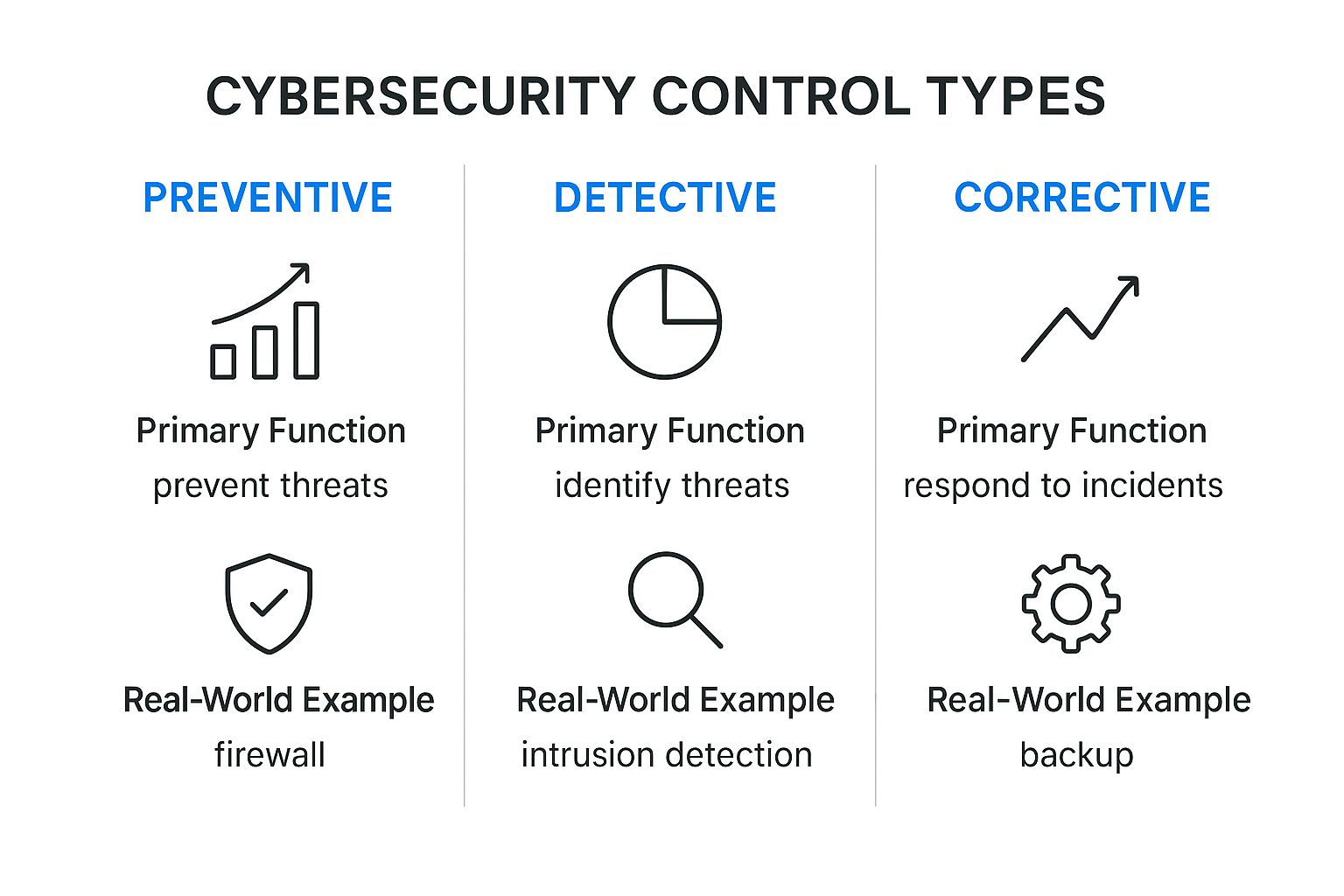
A robust security posture relies on a layered defense that combines all three.
For example, you might install a firewall (preventive) to block malicious traffic at the perimeter. Behind that, an intrusion detection system (detective) looks for any suspicious activity that might have slipped through. And if an attack still succeeds, a solid data backup and recovery plan (corrective) allows you to restore your systems. This defense-in-depth approach means that if one layer fails, you have others in place to catch, contain, or fix the problem.
Developing Your Incident Response Framework
Here’s a hard truth: no matter how good your defenses are, you have to assume an incident will happen eventually. An Incident Response (IR) plan is your playbook for that moment. It’s what separates a manageable event from a full-blown catastrophe. A well-rehearsed plan minimizes damage, shrinks recovery time, and ensures everyone acts with purpose, not panic.
This is where the rubber really meets the road. Interestingly, research shows a confidence gap in this area. While 74% of businesses say they're confident in their real-time response capabilities, that number varies. A striking 81% of C-suite leaders feel confident, but that drops to just 66% among front-line managers—a clear sign of a disconnect between strategy and execution. Technology is helping bridge that gap, with 42% of organizations reporting more efficient IR plans thanks to AI.
A detailed incident response plan is your fire drill for a cyberattack. Practicing it ensures that when the alarm sounds, your team acts with precision and purpose instead of panic and confusion.
A solid IR plan typically moves through these key phases:
- Preparation: This is the homework you do before an incident. It involves assembling your IR team, getting the right tools in place, and running drills so everyone knows their role cold.
- Detection & Analysis: How will you know you've been hit? This is all about monitoring your systems for signs of trouble and quickly figuring out if an alert is a real threat or just noise.
- Containment: Once you confirm a breach, the immediate priority is to stop the bleeding. This often means isolating affected servers or laptops from the network to keep the attack from spreading further.
- Eradication & Recovery: After containing the threat, you need to kick the attacker out for good and restore your systems from clean backups. To get this right, our guide on data breach damage control can help you avoid common pitfalls.
- Post-Incident Activity: This is where you learn and get stronger. Hold a lessons-learned session to review what went right, what went wrong, and how you can improve your defenses and your response plan for next time. To round this out, a comprehensive Business Continuity Plan template and guide is also crucial, ensuring the business itself can keep running through a major disruption.
Turning Your Plan Into a Living Security Program

Crafting a detailed cybersecurity risk management plan is a huge win, but let's be honest—its real value isn't realized until it jumps off the page and into your day-to-day operations. A plan collecting digital dust is worthless. Security isn't a project with a finish line; it’s a living program that has to breathe and adapt right alongside your business.
This is where I’ve seen many organizations stumble. They treat the completed plan as the end goal when it's really just the starting pistol. Transforming that document into a functional security program takes deliberate action, consistent oversight, and a real commitment to evolving.
Securing Executive Buy-In and Defining Roles
Your first move isn't technical, it's political. You need genuine buy-in from the top, and I don't just mean a quick signature on a policy document. Leadership needs to see this program for what it is: an essential business function, not just another IT expense.
When you have that conversation, frame it around business enablement and protecting the bottom line. Show them exactly how this program safeguards the assets that actually generate revenue.
With leadership on board, the next step is crystal-clear roles. Ambiguity is the enemy of good security. Everyone, from the C-suite to the front desk, needs to know what part they play. This isn't just about handing tasks to the IT team.
- Executive Sponsor: Who’s the champion in the boardroom? This person fights for your budget and helps clear organizational hurdles.
- Security Lead/Manager: Who owns the day-to-day execution? This is your point person for monitoring controls, reporting metrics, and leading incident response.
- Department Heads: What’s their role in enforcing policies? The finance department, for example, is on the front line against business email compromise and needs to be equipped.
- All Employees: Every single person has a responsibility to follow policy, report anything suspicious, and actually participate in training.
Clearly documenting and communicating these roles eliminates the finger-pointing that happens during a crisis and helps build a culture where everyone feels a sense of ownership.
Rolling Out Effective Awareness Training
Your tech stack alone won't stop every threat. Your people are a crucial layer of your defense, but only if they're properly trained. A staggering number of breaches can be traced back to simple human error. Good security awareness training flips that vulnerability into a strength.
This can't be a boring, once-a-year slideshow that everyone just clicks through. To be effective, it must be ongoing, engaging, and directly relevant to people's jobs. I've found a mix of formats works best:
- Interactive Modules: Use short, web-based training on core topics like spotting phishing emails, creating strong passwords, and browsing safely.
- Simulated Phishing Tests: These are invaluable. Sending safe, simulated phishing emails gives your team real-world practice and provides you with concrete data on where your weak spots are.
- Regular Security Reminders: Use company newsletters or team huddles to share quick updates on new threats or to reinforce key security habits.
Your goal isn't just to check a compliance box. It's to genuinely change behavior and empower your team to become a human firewall. When an employee spots a phishing attempt and reports it, you know your program is working.
Monitoring, Measuring, and Adapting Your Program
A living security program needs constant attention. You have to get into a rhythm of monitoring your defenses, measuring how they’re performing, and adapting to a threat landscape that changes by the minute.
Start by defining your Key Performance Indicators (KPIs). These are the hard numbers that tell you if your plan is actually effective. Good examples include:
- Mean Time to Patch (MTTP): How fast are you closing critical vulnerabilities once they’re disclosed?
- Phishing Simulation Click-Rate: What percentage of users are clicking on your test emails? More importantly, is that number going down over time?
- Number of Security Incidents Reported: A rise in this number isn't always a bad thing! It can be a great sign that your awareness training is sinking in and people are getting better at reporting.
Schedule regular reviews of your entire plan—at least once a year, or anytime a major business change happens, like an acquisition or a new product launch.
Real-world events are the ultimate test. What happens when a massive vulnerability like Log4j drops? Your program needs a clear process to find affected systems and patch them—fast. By treating your cybersecurity risk management plan as a continuous cycle of doing, measuring, and improving, you build true, lasting resilience. You create a security program that doesn't just look good on paper but actively defends your organization every single day.
Frequently Asked Questions
Putting a cybersecurity risk plan down on paper is one thing; making it work in the real world is another. In my experience, this is where the most practical questions pop up. Let's walk through some of the common hurdles I see companies face when they move from theory to action.
How Do I Scale This Plan for My Business Size?
This question comes up a lot, and the answer isn't to create entirely different plans. The fundamentals—knowing your assets, understanding the risks, fixing the problems, and keeping an eye on things—are universal. The real difference is in the depth and formality.
If you’re a small business, you can keep things lean and focused. Your asset inventory might just be a well-organized spreadsheet, not some complex, expensive software. Your risk assessment can be straightforward, using a simple "high, medium, low" scale to quickly flag major threats like ransomware or phishing, which are devastating for smaller teams. Your energy should go into the essentials: solid backups, multi-factor authentication (MFA) everywhere you can put it, and basic security training for your people.
For a large enterprise, the scale of the problem is just bigger. You've got a massive attack surface, so your plan naturally becomes more structured and needs more resources. We're talking about:
- Quantitative Risk Analysis: You’ll need to put actual dollar amounts on risks to get approval for those six- or seven-figure security investments.
- Dedicated Teams: You’ll have people whose entire job is threat intelligence, incident response, or compliance. It's a different world.
- Advanced Tooling: You'll be using enterprise-grade tools like a Security Information and Event Management (SIEM) system or Endpoint Detection and Response (EDR) to see what's happening across thousands of devices.
It’s all about making the plan fit the organization, not the other way around.
What Is the Best Way to Justify the Cybersecurity Budget?
You'll never get the budget you need if you talk to leadership about firewalls and software. You have to speak their language, which is the language of business risk. They want to know about financial losses, operational downtime, and damage to the company's reputation.
Instead of saying, "We need a new firewall," frame it like this: "Our risk assessment shows a 40% chance of a business email compromise attack this year, which could cost us around $150,000. For an investment of $15,000 in a new firewall, we can cut that risk by 90%."
That's a conversation a CFO can get behind. Use the data you've gathered. Reference credible, third-party statistics. For instance, the FBI reported that cybercrime losses in the U.S. ballooned to $12.5 billion in 2023. When you bring hard numbers like that to the table, you're not asking for an expense—you're proposing a smart investment to protect the business.
What Are the Most Common Implementation Mistakes?
I've seen some truly brilliant plans fall apart during implementation. It almost always comes down to a few common, avoidable mistakes.
First and foremost, people treat the plan like a one-and-done project. It’s not. It's a living program. Threats evolve, your business changes—the plan has to keep up. It should be revisited at least once a year, or anytime there's a major shift in your business.
Another classic mistake is poor communication. If your employees don't know why you’re adding a new security step, they'll just see it as a hassle and find ways around it. You have to explain the "why" behind the "what." This makes ongoing security awareness training absolutely non-negotiable.
Finally, you have the "somebody-else's-problem" syndrome. When you don't assign clear ownership, nothing gets done. If everyone is responsible, then nobody is. Make sure specific people are accountable for monitoring risks, leading incident response, and reporting on progress. It’s the only way to keep the wheels turning.
Trying to manage your own technology and cybersecurity can pull you away from what you do best. InfoTech Enterprise Solutions offers all-inclusive managed IT services designed to take that entire burden off your shoulders. We handle everything proactively—from monitoring and patching to data backups and disaster recovery—to keep your systems running smoothly and securely. For predictable, expert IT support that frees you to grow your business, partner with us. Discover a better approach to IT with InfoTech Enterprise Solutions.


Leave a Reply