
So, what exactly are managed IT services for law firms?
Think of it this way: instead of calling a tech support company only when something breaks, you partner with a specialized firm that manages your entire technology environment. They work behind the scenes to keep everything running smoothly, securely, and efficiently—all for a predictable monthly cost. It’s the difference between having a mechanic on call and having a dedicated pit crew constantly tuning your engine to prevent breakdowns in the first place.
Why Your Law Firm Needs Managed IT Services
Imagine your practice operating without the constant, nagging worry of tech failures, data breaches, or compliance nightmares. That’s the peace of mind a good managed service provider (MSP) can deliver. They don't just fix broken laptops; they act as your dedicated technology partner, proactively overseeing your whole IT infrastructure.
It’s like having an entire elite IT department—with experts in cybersecurity, cloud systems, and legal-specific software—at your disposal, but for a fraction of the cost of hiring a full-time team. This approach turns IT from a reactive, unpredictable expense into a strategic advantage that protects your firm, your clients, and your valuable billable hours.
To see how these two models stack up in the real world, let's compare them side-by-side.
Comparing In-House IT and Managed IT Services
| Aspect | Traditional In-House IT | Managed IT Services |
|---|---|---|
| Cost Structure | High fixed costs (salaries, benefits) + unpredictable capital expenses for new hardware and software. | Predictable, fixed monthly fee. Operational expense (OpEx) instead of capital expense (CapEx). |
| Expertise | Limited to the skills of your hired staff. It's tough for a small team to be experts in everything. | Access to a deep bench of specialists in security, cloud, compliance, and specific legal applications. |
| Support Availability | Typically 9-to-5, with after-hours support being difficult or expensive to arrange. | 24/7/365 monitoring and support are standard, ensuring issues are addressed immediately, day or night. |
| Approach to IT | Reactive. The "break-fix" model means problems are only addressed after they cause downtime. | Proactive. Continuous monitoring and maintenance aim to prevent problems before they can impact your work. |
| Scalability | Scaling up or down is slow and costly, requiring new hires or layoffs. | Easily scalable. You can adjust your service plan as your firm grows or your needs change. |
The takeaway is clear: the MSP model is built for the flexibility, security, and uptime that a modern law firm demands.
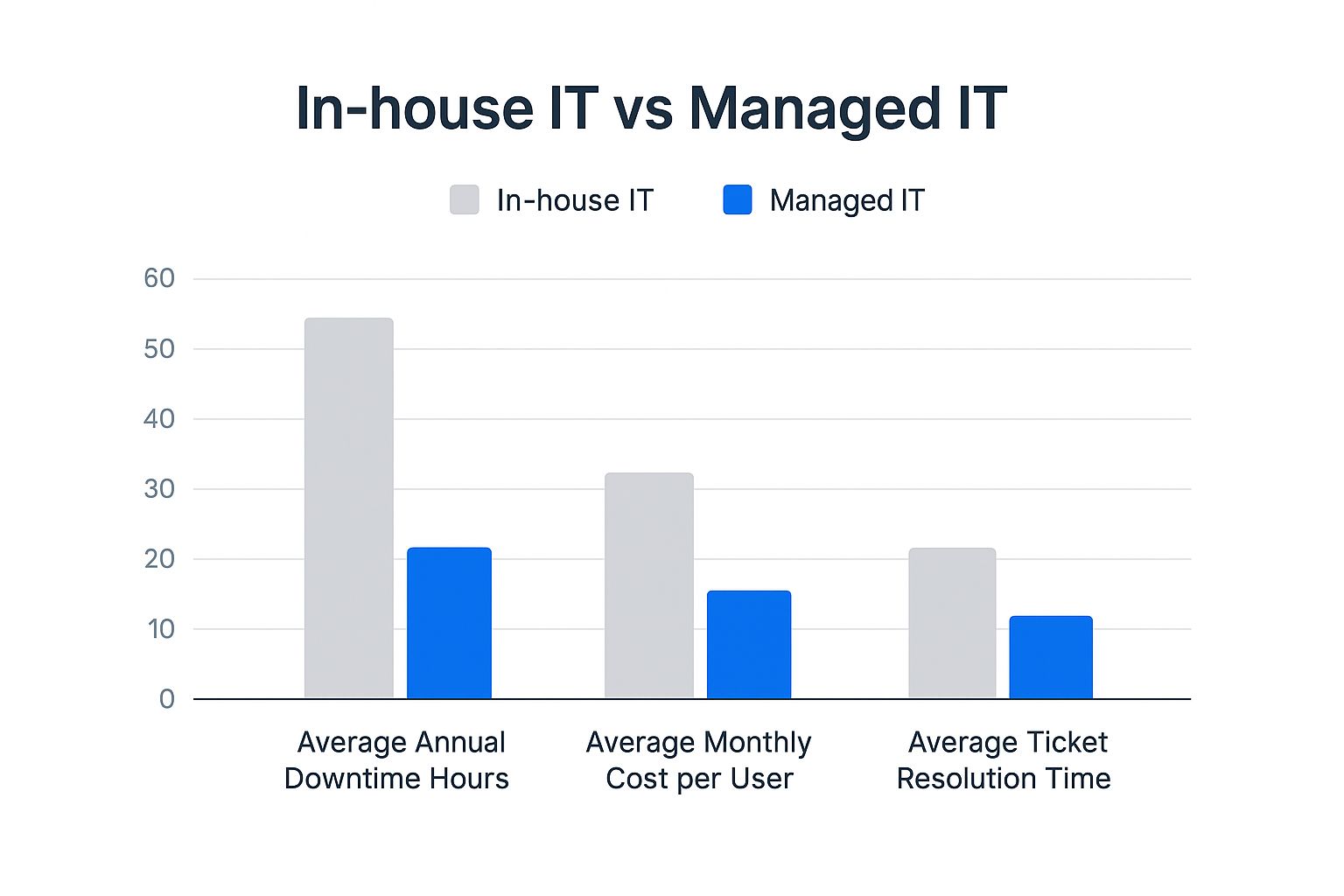
As the numbers show, embracing managed services can drastically cut down on costly downtime and get issues resolved much faster, all while making your budget far more predictable.
Moving Beyond Basic Tech Support
Many firms are still stuck in the old "break-fix" cycle. A server crashes or a lawyer’s laptop dies, you frantically call for help, get a bill for the emergency service, and lose precious billable hours in the process. This reactive approach isn’t just inefficient; it's a direct threat to your firm's profitability.
A proactive IT strategy isn't just a nice-to-have; it's essential. Consider that 27% of law firms report having experienced a data breach. The managed services model is built on prevention, which is absolutely critical for safeguarding sensitive client data and upholding attorney-client privilege.
Managed IT services for law firms completely flip this script. Your MSP is always watching your network, installing security patches before vulnerabilities are exploited, and managing your data backups to ensure you can recover from anything. This constant vigilance prevents most issues from ever happening. The result is a stable and secure technology foundation that lets you and your team focus on what you do best: practicing law.
Key Benefits of Specialized Legal IT Support

When you team up with an IT provider who genuinely gets the legal world, the results aren't just technical—they show up on your bottom line. Any generic IT company can fix a printer, but managed IT services for law firms understand that every second of downtime is a lost billable opportunity. It’s this deep industry focus that turns abstract tech support into a real competitive edge for your practice.
The first thing you'll notice is how much less time you spend fighting with technology. A provider who knows legal tech doesn't just react to problems; they proactively manage your systems to stop issues before they can throw a wrench in an attorney's packed day. That means fewer frozen screens and more time dedicated to what actually matters: your clients and their cases.
Access Deep Expertise Without the Overhead
Let's be realistic. Hiring a full-time, in-house expert for every piece of technology your firm relies on—from cybersecurity to intricate e-discovery platforms—is a financial non-starter for most law practices. A specialized managed services provider (MSP) gives you something better: an entire team of professionals who live and breathe the unique challenges of legal IT.
This collective knowledge is a game-changer. For example, they won't just suggest any old cloud storage. They'll guide you to a solution that meets the strict data residency and compliance rules governing legal documents. You get the kind of high-level expertise that major corporations have, but without the crushing payroll costs.
The global market for managed IT services is projected to hit USD 329.1 billion by 2025—a clear sign that businesses, especially law firms, are catching on to this value. This boom is fueled by the growing need for expert help in tricky areas like cybersecurity and regulatory compliance. You can learn more about these market trends and what they mean for firms on veritis.com.
Achieve Predictable Costs and Effortless Scalability
One of the biggest headaches for any firm is unpredictable IT expenses. A server that suddenly dies or an unexpected software license renewal can completely derail your budget. The MSP model smooths all that out. You pay a predictable, flat monthly fee that covers everything from day-to-day support to preventative maintenance.
This financial predictability comes with another huge plus: scalability. Your IT services can grow and shrink right alongside your firm, effortlessly.
Think about it:
- Hiring new associates? Your provider can spin up new user accounts, set up their hardware, and grant access to your case management system in no time.
- Taking on a massive case? Services can be ramped up to handle the huge data loads required for e-discovery and document review.
- Navigating a slower period? Your plan can be adjusted, so you’re only ever paying for what you truly need.
This kind of flexibility ensures your technology is always a perfect fit for your firm's immediate needs. By choosing specialized managed IT services for law firms, you’re not just buying tech support; you're investing in a partnership designed to make your practice more efficient, secure, and ultimately, more profitable.
Protecting Your Firm and Upholding Client Trust
In the legal world, data security isn't just an IT issue—it's a direct measure of your firm's commitment to its ethical and professional duties. Protecting sensitive information is the bedrock of attorney-client privilege. This is where specialized managed IT services for law firms step in, not just as a vendor, but as your digital guardian in a very complex regulatory environment.
Think of a good Managed Services Provider (MSP) as both the architect and the warden of a digital fortress built around your firm's data. They don't just react to problems; they proactively design, build, and manage layers of defense. These defenses are specifically meant to stop the kinds of modern cyberattacks that single out legal practices. It’s a comprehensive strategy to secure every possible way in.
Building a Proactive Security Posture
A proactive security posture is all about anticipating threats, not just cleaning up after them. Your MSP gets this done through a few key actions:
- Multi-Factor Authentication (MFA): This adds a critical second security check beyond a simple password, usually requiring a code from your phone to grant access. Honestly, it's one of the single most effective ways to block someone from getting into an account they shouldn't.
- End-to-End Data Encryption: This process scrambles your data, making it completely unreadable to anyone who doesn't have the specific key to unlock it. It doesn't matter if the data is sitting on a server (at-rest) or flying across the internet in an email (in-transit)—encryption keeps it confidential.
- Advanced Threat Detection: A modern MSP uses sophisticated tools, like Endpoint Detection and Response (EDR), that actively hunt for suspicious behavior on your network. This is how you stop threats like ransomware before they can lock up your critical case files.
These aren’t just abstract ideas; they are your firm’s real-world defenses. Imagine an attorney accidentally clicks a malicious link in a phishing email. Advanced threat detection can immediately isolate that computer before malware spreads, while MFA stops the stolen password from being used to access anything else.
A Partnership in Compliance and Risk Mitigation
Keeping up with regulations like HIPAA or adhering to ABA guidelines is a constant source of pressure for any firm. An MSP that specializes in the legal industry already knows these rules inside and out, acting as your dedicated compliance partner. They make sure your IT systems are built and managed to meet these tough standards, giving you both peace of mind and the documented proof of due diligence you need.
To further strengthen your firm's defenses against cyber threats and ensure client confidentiality, implementing essential data security best practices is crucial.
A data breach can be absolutely devastating, not just financially, but to your firm's hard-won reputation. The right MSP helps you manage this risk by building a resilient security framework that actively defends against the most common and damaging attacks targeting law firms today.
Recent industry data shows how much this focus on security has grown. Even though over 60% of firms now have formal cybersecurity policies, ransomware and phishing are still major, persistent threats. The good news is that the rise in MFA adoption shows a clear effort to fight back, with managed IT services being a primary driver of this shift.
Ultimately, safeguarding client trust is non-negotiable. When you partner with a qualified MSP, you're handing off the complex, time-consuming work of cybersecurity to experts. This frees you up to focus on your clients, confident that their most sensitive information is protected. For more specific advice, take a look at our guide on the 10 steps to prevent a data breach.
What Core Services Should Your Law Firm Expect?

When you team up with a managed service provider (MSP), you're getting far more than a simple IT helpdesk. You're bringing on a partner dedicated to a whole suite of proactive services designed to keep your practice humming. While packages can differ, any provider worth their salt in the legal industry will offer a specific set of services—the absolute essentials for a modern, secure law firm.
The cornerstone of it all is 24/7 proactive network monitoring. This isn’t about just waiting for something to break. Instead, your MSP uses sophisticated tools to keep a constant eye on your network's health and performance. They spot and resolve potential problems before they can disrupt your day and chew into billable hours. This constant watchfulness is what truly sets managed services apart from the old "break-fix" IT model.
Secure Access and Effortless Collaboration
Legal work rarely happens just within the four walls of an office anymore. Attorneys need to access case files securely whether they're in court, working from home, or visiting a client. This is where managed cloud services really shine.
Your MSP will set up and oversee secure cloud platforms for your most important software, especially your document and case management systems. This gives your team the freedom to work from anywhere without ever putting sensitive client data at risk. In fact, providing effective document management for law firms is one of the most significant ways an MSP can boost a firm's efficiency and data security.
A great MSP serves as your firm's technology quarterback. They make sure every piece of your tech stack—from the phone system to your case management software—plays well together. This unified strategy means you're not stuck trying to wrangle different vendors, resulting in a more reliable and frustration-free IT environment.
Protecting Your Firm from Disruption
What would your firm do if a fire, flood, or major server crash made your office unusable? A good MSP answers that question with a solid business continuity and disaster recovery (BCDR) plan. This is much more than just backing up your files.
- Reliable Data Backup: This includes regular, automated backups of all critical firm and client data. Crucially, these backups are tested frequently to guarantee they can be successfully restored when you need them most.
- A Clear Disaster Recovery Plan: Your MSP will have a detailed, step-by-step plan to get your systems back online as quickly as possible after a major incident, keeping downtime to an absolute minimum.
- A Smart Business Continuity Strategy: This ensures your team can keep working even if they can't get to the office by having secure, cloud-based tools and remote access ready to go.
Other essential services often include managed VoIP phone systems for crystal-clear communication and vendor management. With vendor management, your MSP acts as the single point of contact for all your tech suppliers, from your internet provider to your legal software company. This means you make one call, and they take care of the rest, letting you get back to what you do best: practicing law.
Putting AI and Modern Tech to Work for Your Firm
In today's legal world, staying competitive isn't just about legal skill; it's about using technology as a genuine strategic advantage. A great managed IT services provider for law firms acts as your guide, helping you bring advanced tools like Artificial Intelligence into your practice safely and effectively.
This isn't some far-off sci-fi concept. We're talking about practical tools that give you a real edge right now. Picture an AI-powered e-discovery system that plows through terabytes of documents in hours, not months, flagging key evidence with pinpoint accuracy. Think about AI-driven research tools that can pull up relevant case law and statutes in seconds, dramatically speeding up case preparation.
Your MSP's Role in Tech Adoption
Your managed services provider should be more than just a help desk; they should be your technology advisor. They’re the ones who evaluate new tools, implement them securely, and make sure they play nicely with your existing systems—all while keeping your ethical and security obligations front and center.
The real value of an MSP here is that they close the gap between powerful new technology and the daily grind of practicing law. They handle the technical headaches so your firm can get the benefits without the risks of trying to go it alone.
This kind of partnership gives firms of any size access to capabilities that were once exclusive to the big players. You can also get expert guidance on things like exploring the top AI chatbot solutions for websites to better engage with potential clients online.
The move toward AI is happening, and it's happening fast. Recent reports show a major strategic shift, particularly in larger firms. The data is clear: 39% of firms with 51 or more attorneys have already put generative AI to work in their legal processes. For smaller firms, that number is around 20%. And across the board, 54% of legal professionals are now using AI to help draft correspondence. You can dive deeper into these findings in the full 2025 legal industry report.
But this doesn't mean smaller firms are being left in the dust. Many are finding smart ways to use these tools to punch above their weight. There are some great examples of how AI is helping small businesses of all kinds. By working with the right MSP, your firm can step confidently into this new era of legal technology.
How to Choose the Right IT Partner for Your Firm

Picking a Managed Service Provider (MSP) is one of the most critical technology decisions your law firm will ever make. This isn't just about hiring a company to fix your computers; it's about bringing on a strategic partner who will have direct access to your most sensitive client data. Get it right, and your practice thrives. Get it wrong, and you’re opening the door to massive risk.
Your entire evaluation process should begin with one simple question: do they have real, proven experience working with other law firms? A generalist IT provider simply won't get the unique pressures of legal work, from the sanctity of attorney-client privilege to the complex compliance rules you live by. An MSP that specializes in the legal field already speaks your language and understands your professional obligations.
Verifying Legal Tech Expertise
Once you’ve established they work with firms like yours, it's time to get specific. You need to know if they have hands-on experience with the exact software your firm depends on every single day. Their familiarity—or lack thereof—with your core tools will directly impact the quality of support you receive.
Don't hesitate to ask them pointed questions about their experience with:
- Case Management Software: Have they actually managed and supported platforms like Clio, PracticePanther, or MyCase?
- Billing and Time-Tracking Tools: Do they understand how these crucial systems need to integrate with your other technology?
- E-discovery Platforms: Can they handle the intense technical demands of modern e-discovery?
A provider that has never even heard of your case management software cannot proactively manage it. Their lack of familiarity means they will be learning on your dime, reacting to problems instead of preventing them—the exact opposite of what managed services should be.
Scrutinizing Security and Agreements
After confirming their legal tech expertise, your next move is to dig deep into their security protocols and the fine print of their agreements. You should feel comfortable asking for the specifics of their incident response plan—what is their step-by-step process if a data breach hits?
Take a hard look at their Service Level Agreement (SLA) to understand their guaranteed response times and commitments to system uptime. While a glowing referral from another law firm is a great start, it doesn’t replace the need for your own thorough vetting process.
For a deeper dive into the general qualities of a top-tier provider, our guide explains what to look for when choosing an MSP for your business. Making a confident decision comes down to finding a partner with proven expertise and truly transparent practices.
Frequently Asked Questions About Legal IT Services
https://www.youtube.com/embed/-r8-oYXjkUs
It's only natural to have questions when you're thinking about bringing on a technology partner. Let's walk through some of the most common ones we hear from law firms to help you get a clearer picture.
What Is The Typical Cost Structure?
Most managed IT services for law firms run on a straightforward, subscription-based model. Forget about the sticker shock of massive hourly bills for emergency fixes. Instead, you pay a consistent monthly fee for ongoing, proactive management and support.
This shifts your IT budget from a reactive, unpredictable capital expense (CapEx) to a stable operational expense (OpEx). It makes financial planning much simpler and, just as importantly, it means your provider’s success is tied to yours. Their goal is to keep things running smoothly to prevent problems, not to profit from your downtime.
Will We Lose Control Over Our IT?
Absolutely not. This is a common concern, but a good managed services provider (MSP) works with you, not for you in a way that takes over. They are a strategic partner, and you always keep full ownership and final say over your firm’s technology and data.
Here's a good way to think about it: You're the captain of the ship, charting the course and making the big decisions. Your MSP is the expert engineering crew, handling the complex machinery below deck to make sure the voyage is smooth and secure. They manage the day-to-day technical details so you can focus on practicing law.
One of the biggest myths is that outsourcing IT means giving up control. The reality is you gain more control over what really matters—reliability, security, and results—by delegating the technical work to specialists who are accountable for keeping everything running perfectly.
How Quickly Can We Expect Support?
Response times are a non-negotiable part of any service agreement and should be spelled out in black and white in your Service Level Agreement (SLA). The best providers offer 24/7/365 helpdesk support to tackle issues the moment they pop up.
Think about it—your team is working late on a Saturday to prepare for a major trial, and a critical system goes down. You can't afford to wait until Monday morning for a fix. This kind of round-the-clock availability is one of the core reasons firms choose managed IT services.
Ready to eliminate IT distractions and secure your firm's future? InfoTech Enterprise Solutions delivers expert managed IT services with predictable costs and unparalleled local support. Learn how we can empower your practice today.


Leave a Reply